My Espoo on the Map: Walking and driving take turns in the everyday life of Espoo residents
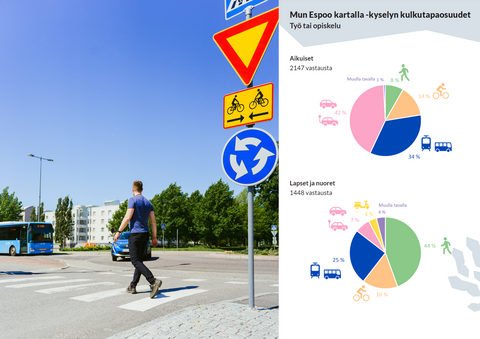
In the My Espoo on the Map survey, respondents marked important everyday places on a map and shared how they get there. The results provide valuable insight into the mobility habits of Espoo residents and how they feel about their everyday environments in terms of mobility.
In autumn 2024, approximately 5,000 Espoo residents responded to the survey. The respondents marked places that are important to them or should be developed on the map. Easily over one third of the respondents were children and young people.
According to Planning Manager Samuel Tuovinen, the data from the My Espoo on the Map survey will help understand the residents’ experiences with mobility:
‘The user volumes of different modes of transport and the related trends give us a wide range of data that helps with traffic planning during zoning processes. The My Espoo on the map survey helped us obtain experience-based data from residents in particular. We now have a better understanding of, for example, residents’ experiences of the pedestrian areas near stations and schools.’
For city planners, the extensive material from My Espoo on the Map is a treasure chest of resident data, which can be used for many years. This series presents the results from different perspectives.

By foot or bicycle to school, daycare and recreation
When adults were asked how they take their children to day-care centres or schools, the most popular answer was by foot. On the other hand, walking is only slightly more popular than driving, but combined, walking and cycling are clearly more popular than driving and public transport combined.
The parents responded very similarly in a separate drop-off survey from 2024 which had almost 5,000 responses from the guardians of children in day-care centres and schools.
More than half of school-aged children and young people who responded to the My Espoo on the Map survey said that they get to school by foot or by bicycle. One fourth of the respondents uses public transport, and only seven per cent get a car ride to school.
The distances for the children and young people who responded to get to school varied from 100 metres to over ten kilometres. The shortest distances are for children going to primary schools, while the longest distances are for students in vocational studies, general upper secondary school, and education in other languages.
Both adults and children also avoid motorised transport when going to recreational places or other places of personal importance. Half of the adult respondents and 45% of children and young people walk to places of recreation. In questions about recreational sites, cycling and walking combined were clearly the most popular modes of transport. This seems to indicate that nature and local recreational areas are suitably close for the majority of Espoo residents.

By car to work, shopping and hobbies
The car is still an important mode of transportation for many Espoo residents. A little more than 40% of the respondents stated that they drive to work or their place of study. However, the proportion of people who commute by public transport has increased slightly since 2020 when this survey was first conducted.
Since 2020, Länsimetro and light rail line 15 have become competitive new commuting options for some. On the other hand, the discontinuation of some direct bus lines to Helsinki has caused some Espoo residents to switch the bus to a car.
The car was clearly the most popular choice for shopping and groceries. Nearly 60% of adult respondents drive when they go shopping, even though all the largest shopping centres in Espoo are located by a metro or railway line. This means that parking facilities at shopping centres must still be taken into account in the future.
In addition, the car was the most popular response for getting to hobbies, services, or cultural events. About 50 per cent of adults drive in these cases. On average, children and young people walk and cycle more than adults, but a significant proportion of them - 36 per cent - also travel by car to get to hobbies and culture. This figure may indicate that places for hobbies are not evenly located around Espoo. Moreover, some hobbies require transporting hobby equipment, for which a car is a better fit than other modes of transport.
Public transport and cycling popular again after the pandemic
The previous My Espoo on the Map survey was conducted in 2020. At that time, the coronavirus significantly affected people’s mobility habits, particularly decreasing the use of public transport. Espoo’s traffic review 2025 indicates that traffic habits are returning to normal. The use of public transport has increased by 54 per cent between 2020 and 2024, cycling by seven per cent, and driving by five per cent.
See Espoo’s traffic review 2025 (only in Finnish)
Check out the other stories in the series:
First results of My Espoo on the Map 2024 now out
The places named by children and young people as best in Espoo are close
Nature responses revealed what type of urban green Espoo residents want to see