Graduates' thoughts on upper secondary school and studying, in autumn 2025
In the autumn of 2025, a total of 307 students graduated from upper secondary schools in Espoo – among them Nella, Sofia, Lejonka and Alex. They share their thoughts on upper secondary school, studies, and the matriculation exams, as well as life lessons they've learned. They also offer advice and tips, drawn from experience, to those who are still in school or just about to begin.

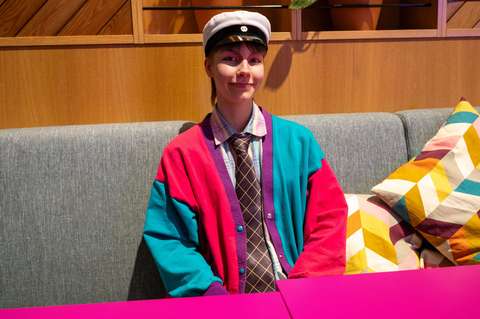
Nella Huikko graduated from the visual arts line of Viherlaakson lukio upper secondary school. Nella earned excellent grades in the matriculation examination. They praise the teachers at their upper secondary school and encounters with them.
Nella Huikko graduated from Viherlaakson lukio upper secondary school. “Now, I feel relieved,” Nella says. Nella got excellent grades in the matriculation examination, the highest grade in five subjects and second highest in one. Their psychology grade was only one point away from full points.
Nella applied for the visual arts line of Viherlaakson lukio upper secondary school because they wanted to continue studying visual arts that they had started in comprehensive school. Nella considered the Visual Arts School of Helsinki, Upper Secondary School, but they were afraid that its level would be too high. “The idea that at Viher visual arts would be a bonus felt good. It does not sideline other subjects, as it would have done in a specialised upper secondary school,” Nella sums up. The bus journey from Veikkola was also reasonable.
Nella had hardly any old friends in the same school, but they have found new ones. On the very first day of their studies, Nella was looking for the school cafeteria with another student sharing the same group guidance lessons. After finding the cafeteria, they went to eat together: “We’re still friends. I wouldn’t have believed I’d make as many friends in upper secondary school as I’ve made.”
Inner motivation led to good results
In Nella’s opinion, the best things about Viherlaakson lukio upper secondary school were the atmosphere and the wonderful teachers. Nella mentions by name the resource teacher and community instructor Petteri Eränkö, who “lights up the place”. As their best memories of the upper secondary school, Nella also mentions after-class discussions with teachers. Nella remembers with particular warmth when the retiring mathematics teacher gave them a hug.
Nella also praises various events at the school, such as the wellbeing week and other campaigns. They also appreciate the upper secondary school’s working group on wellbeing and the contact persons for harassment operating there, even though they did not have any personal need for their services (each upper secondary school in Espoo has trained 2 staff representatives as contact persons for harassment).
In Nella’s opinion, the contributing factor to the good matriculation examination score was their own inner motivation. Nella also felt that as general upper secondary level education is provided free of charge by the state, they wanted to do well in their studies. The good academic success has raised the bar but thus also the pressures. Nella has received a lot of support from their parents and teachers. "Whenever we had any questions, the teachers answered them. The teachers exuded enthusiasm for their own subjects. The psychology teacher once even answered questions outside the lessons for a couple of hours. The maths workshop (mathematics remedial instruction) gave us a chance to ask more questions, as there was not always time for additional questions during the lessons,” Nella says.
The general upper secondary school provides good prerequisites for becoming a visual artist
When starting their upper secondary school studies, Nella considered working in the field of visual arts to be a potential future plan for them – perhaps working as an illustrator or visual arts teacher. “For me, visual arts is a hobby, and I don’t want to turn something that is a hobby into my work.” However, in Nella’s opinion, the upper secondary school provided good prerequisites for making visual arts a profession. The courses included learning how to prepare your own portfolio you will need as an artist. The upper secondary school diploma in visual arts in particular taught about this.
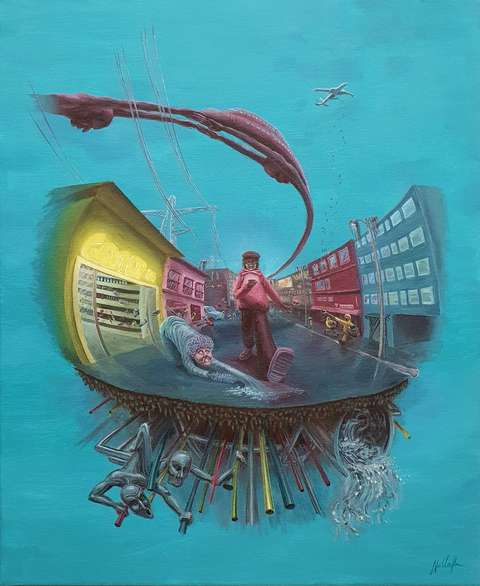
Nella completed a general upper secondary school diploma in visual arts on the topic of everyday life. Their work was called Piittaamattomankin puolesta (acrylic). In their diploma work, Nella studied how many people overlook such people as cleaners or maintenance workers and do not understand how much we need such people. They are being ignored and instrumentalized – a bus driver is just an instrument of getting from one place to another. Nella tells they had a summer job working as a cleaner at Karamzinin koulu school and praises the nice work community.
The human mind interests Nella
Nella intends to apply to study psychology at the University of Helsinki next spring. Their excellent grade in the matriculation examination will certainly help them towards that goal. Nella is interested in the human mind, and they want to be able to help people with mental health challenges in particular.
What the upper secondary school years taught Nella was that grades do not matter if they don’t serve a bigger purpose, if you don’t need the grade for something or if they don’t matter to yourself. If Nella could do something differently from their upper secondary school years, they would focus more on relationships and friends. “In your everyday life, there must be room for moments when you recover and spend time with friends."
Finally, Nella wants to say to younger students that every general upper secondary school provides good capabilities for further studies. “Follow the things that you feel good about.”
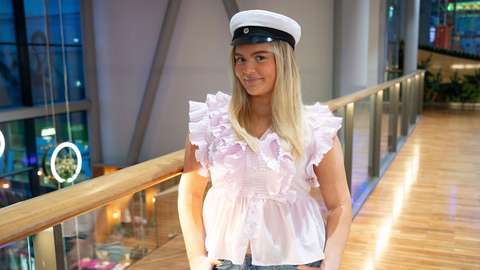
Sofia Kaurinkoski graduated from Espoon yhteislyseo upper secondary school. She got excellent grades in the matriculation examination. Next, she will get prepared for further studies.
Sofia Kaurinkoski graduated from Espoon yhteislyseo upper secondary school. She successfully raised couple of her grades from the first rounds of exams. “In English, my goal was to get the second highest grade. It was disappointing to get the fourth highest grade for it. I studied a lot the first time, but I slept poorly and felt nervous about the exam. In other words, the score was more due to my ability to perform than my actual skills,” Sofia says. On the second time, according to her own words, Sofia didn’t read much but was able to relax more during the exam – and she got the second highest grade she had aimed at. Sofia raised her grade for Swedish from the third highest to the second highest level. Sofia’s advice to those younger than her is to listen to the teachers during the lessons. “Often, students play games on their computer during the lessons instead of listening,” Sofia points out.
Sofia’s Swedish teacher praises Sofia for being an ambitious and skilled student with a positive attitude towards studying. “She’s both talented and hard working. She’s a good example of how you can achieve good results through hard work,” the teacher says.
To the local upper secondary school for the second year
Sofia spent her first year in another general upper secondary school. “Espoon yhteislyseo was my local school and I had friends here, so I transferred to this school,” Sofia says.
Internationality is very important at Espoon yhteislyseo. During her upper secondary school studies, Sofia was able to participate in a joint study trip to Rome arranged jointly by the courses in religion and history. “Both religion and history had their own theme days, and the students could make wishes on sites to visit in advance. On the history day, we visited, for example, Colosseum and on the religion day St. Peter's Basilica in the Vatican,” Sofia says. The memorable trip lasted four days.
In Sofia’s opinion, the best things at Espoon yhteislyseo were people, the good spirit between teachers and students in particular. When Sofia is asked about her best memories of the school, she hesitates between the senior ball and “penkkarit”, the end-of-school costume party. Finally, she chooses penkkarit. “The great thing about penkkarit was that all seniors participated in it together. Normally, we would stay in our own friend groups,” Sofia says.
Aiming at studying law
At the moment, Sofia is working. In the spring, she intends to apply to study law. Fortunately, the work is part-time, so she also has time to prepare for further studies. She is studying for the entrance examinations, but she will also try to raise her grades so that she would be admitted based on her certificate. At her own school, Sofia has had the opportunity to hear about the field: “At one of the EYL events, there was a lawyer who had been working in the field for a long time talking about their work.” People from different sectors regularly visit Espoon yhteislyseo to talk about their further studies and work.
During upper secondary school years, you learn a lot more than just knowledge. These years are also an important time to grow as a person. Sofia says that during her studies she has learned to be more open and broadminded.
Lejonka Linna graduated from Otaniemen lukio upper secondary school. During their upper secondary school years, Lejonka was able to participate in both the media team and various musical performances. In the future, they want to contribute to helping the planet.
Lejonka Linna graduated from Otaniemen lukio upper secondary school specialising in mathematics and natural sciences (STEM upper secondary school). “Graduation feels like a surprisingly solemn occasion. For a long time, it didn’t feel like much, because in today’s world it’s nothing special to graduate from general upper secondary school,” Lejonka says, describing their feelings. Lejonka has been preparing an upper secondary school student’s speech to their school’s school-leaving ceremony while staying with their grandparents in the Netherlands.
Lejonka has always been interested in STEM subjects (mathematics, environmental studies, natural sciences, and technology), always seeking challenges. “What attracted me in Otaniemen lukio upper secondary school was a wide range of courses and the opportunities offered by a large school,” says Lejonka. “There are a lot of interesting people in Otaniemi that I could get acquainted with. The presentation video conveyed the good spirit prevailing at the school. It also showed that there would be other people very much like me at the school,” Lejonka continues. Lejonka says that the presentation video shown in the comprehensive school already gave them the impression that people at Otaniemen lukio would be open-minded and that, for example, being gay would not be a problem at the school. Lejonka themselves wore tails to the senior ball and led their partner in the traditional dances, and that was no issue whatsoever.
In Lejonka’s opinion, the best thing about Otaniemen lukio was how much students are trusted and how often they are asked for their opinions on different matters. Students feel that they are an important part of the community. “From the first day at school, I have not been able to stop talking about how great Otaniemen lukio is and how very, very satisfied I am with it,” Lejonka says.
Media and music
Although Lejonka was a STEM student, they were involved in many artistic endeavours during their upper secondary school years. Among other things, they joined the media team tasked with photographing and filming at school events. "I love photography and the media team gave me a chance to take pictures." Lejonka also says that they led the media team for six months while the media teacher was absent. Currently, Lejonka has a photography business of their own where they take portraits and family photos. In 2024, they sometimes had even too much work through the business. Lejonka considers it possible that photography could be their day job.
Lejonka was also involved in a wide range of musical activities because they love to sing. “I was in a choir and in different bands during my studies,” Lejonka says. Their best memories of upper secondary school are practising for performances together with schoolmates. Two of Lejonka’s friends from school have now composed and written the lyrics for a song that will be performed at the school-leaving ceremony.
Other people are a resource
Lejonka advises people younger than them to invest in interpersonal relationships in upper secondary school: "Other people are an enormous resource that will help you cope and have fun at high school." During their upper secondary school years, Lejonka has learned to try to reduce their perfectionism: “how to do things well without getting stuck on needing to do one’s best.”
After graduating, Lejonka aims to spend a couple of months in Africa – Kenya, Tanzania and Mozambique interest them in particular. They are fascinated to learn about non-Western cultures. The nature and landscape of the countries also attract them.
In Finland, Lejonka intends to apply to study geography at the University of Helsinki. “I want to be involved in a project that will take the planet forward,” Lejonka says. They would like to be involved, for example, in solving the problem of how, as cities in developing countries grow and countries develop, developing countries could skip the pollution-generating phase.
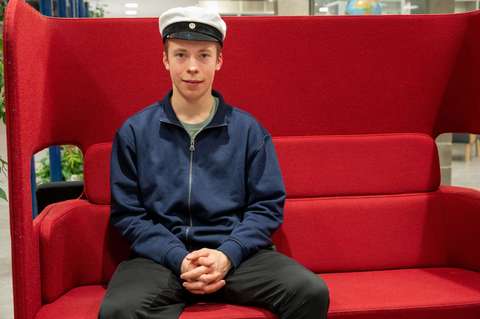
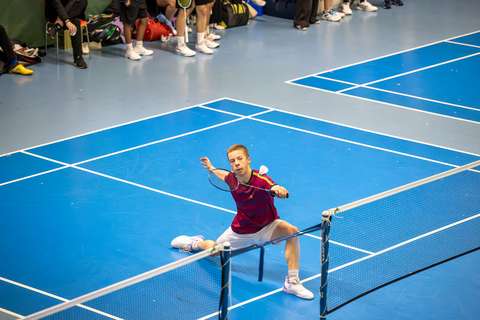
Alex, who graduated from Etelä-Tapiolan lukio upper secondary school, has been a competitive athlete with a rigorous training schedule throughout his studies. After graduation, he will focus on sports.
Alex Gras graduated from Etelä-Tapiolan lukio upper secondary school (Etis). “It feels good to graduate, and it’s liberating as I can now put my all into sports.” And there sure is plenty of sports in Alex’s life.
Alex has been practising badminton for 11 years. During upper secondary school, he has been training twice a day: in the morning before the school starts and, for the second time, after the school day. “When I had a free period, I could go to the gym.” Luckily, as Alex represents Tapiolan Sulka, his training took place only a short distance from his school, at the Esport Center. Alex took his training schedule into account when planning his own school timetable, so sports did not interfere with studies or vice versa. “My studies have gone well, and my school did not have anything against me doing sports either,” Alex says.
From Europe to Etis
Alex applied to Etis because his sister went to the same school and had given him a good impression of the school. Etis was also located close to home, so the distance also affected Alex’s choice. Before, he did not know people of his own age in the area. “The best thing about this place has been that it’s been easy to find friends. “And the teachers here are excellent,” Alex says. His favourite subject was history. Alex thinks the teacher taught it in an interesting and inspiring way. “The way the teacher taught showed how much they enjoyed their work.”
In other respects, Alex’s study path may not have been the most usual one: he went to first grade in Finland and then spent seven years in Brussels. He returned to Finland in the eighth grade. “In Brussels, I went to the European School and there we spoke Finnish – that’s why I could return to a Finnish school.”
Alex thinks that the best memories he has of the upper secondary school are different parties. Alex also remembers well the dressing-up days organised last spring a week before the school-leaving ceremony of last spring’s secondary school graduates. “Although I now graduate in 3.5 years, I have studied at the same pace as those graduating in three years and have always been able to study with people of my age,” Alex says.
Time for sports before the army
During upper secondary school years, Alex learned that not everything needs to be done so seriously. When he began his studies, he wanted to do everything to perfection. The pressures were no longer as high during the last courses, as he knew what he wanted from his future.
After graduating, Alex intends to focus on badminton. His aim is to go as far as possible on his career in Finland and possibly in Europe. However, it will not be easy in the adults’ series to which Alex has now transferred. In addition to playing himself, Alex also coaches kids younger than him. “For me, coaching is one alternative for a profession,” says Alex.
In July, however, he will be going to the army. “After that I thought I’d go to Aalto University to study mechanical engineering.” Alex is interested in designing products.
Alex’s advice to those just starting upper secondary school is to have courage to get to know new people without prejudice.