Congratulations to the upper secondary school graduates of the spring 2026!
In spring 2026, 1,752 new students graduated from the upper secondary schools of Espoo. Congratulations to you all! “May your life be characterised by growth, freedom and responsibility in suitable proportions. Search and explore the world and grow to reach your full potential. But today, it is time to celebrate. Be happy and enjoy yourselves, you deserve it!” says Jussi Paavola, Director of Upper Secondary Education. Elfete, Kawsar, Anina, Ernesti, Petra, Noa, Leo and Aku-Kalle were among the graduates. They share their thoughts about upper secondary school, studies and the matriculation examination as well as the lessons learned in life. They also give advice and tips for those still in upper secondary school or those starting it.

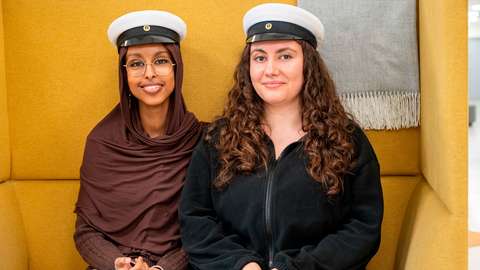
Friends Elfete Zariqi and Kawsar Abdi graduated from Leppävaaran lukio upper secondary school. They were members of the board of the student union from the very beginning of their upper secondary studies.
Elfete Zariqi and Kawsar Abdi graduate from Leppävaaran lukio upper secondary school. Elfete finds graduating exciting. Both feel a little sad. “Upper secondary school went really quickly,” Kawsar says. She is the first one in her family to pass the matriculation examination, so graduation feels particularly great.
One of the reasons why both of them originally chose Leppävaaran lukio upper secondary school was that it was not too near or too far from their homes. When the upper secondary school was not too near, it was possible to learn to know new people. Classmates from Elfete’s comprehensive school came to the same upper secondary school, but they were not actual friends. "I found new friends straight away. Kawsar and I got to know each other on the first day." Kawsar says they "clicked" straight away. Both praise the group tutor for how the tutor received the new students. All the other teachers also made Elfete and Kawsar feel welcome.
Little funny moments
One of the friends of the duo encouraged them to join the board of the student union in the autumn of the first year. Neither of them had yet been interested in that during lower secondary school. On the board of the student union of the upper secondary school, they could contribute to the community spirit of the school and engage in a variety of activities. For example, Elfete and Kawsar had an opportunity to organise a café for different events, a cultural day (e.g,. a henna tattoo workshop) and a May Day event. Both of them remember especially the Olympic Games of their school, which were held at the Kameleonten Sports Centre. The sports in the Games were not the most traditional Olympic sports, but included sumo wrestling and other less obvious ones instead. The students who were not at the sports centre to participate could follow the event on YouTube.
Elfete and Kawsar have many best memories from upper secondary school. Both of them mention the traditional ones, i.e. the seniors’ ball, the “penkkarit” end-of-school celebration and AGT (the Abi goes Tallinn cruise). "Even though I froze at penkkarit," Kawsar recalls. As Elfete says, "all the little occasional moments of laughter with friends in the lessons” are also best memories from upper secondary school.
Kawsar’s favourite subjects in upper secondary school were social studies, history and languages. She and Elfete took a German course together during upper secondary school and helped each other during the course. Elfete’s favourite subjects were English, psychology and visual arts. “Visual arts is a calming subject,” she says. Kawsar praises her friend’s skills in visual arts, including self-made cards and gifts.
Upper secondary school taught to be more open
Both girls say they have become more open during upper secondary school and learned to be open to new experiences. Kawsar has also learned to schedule things, and Elfete has learned patience. "I've learned to ask for help when I need it," Elfete says. However, the duo would not do anything differently in upper secondary school: ”It is what it is.”
After upper secondary school, Kawsar intends to prepare for the entrance examinations of the faculty of law. Elfete has applied to university to study psychology and to become a class teacher, but she is also interested in studying English and working as a flight attendant.
Finally, Kawsar and Elfete want to advise those starting upper secondary school. According to Kawsar, upper secondary school was talked about as a horribly difficult place in lower secondary school. "But upper secondary school isn't that hard or stressful. You’ll be fine as long as you listen in the lessons,” she says. Elfete agrees: "Everything will be ok. Trust the close people around you.”
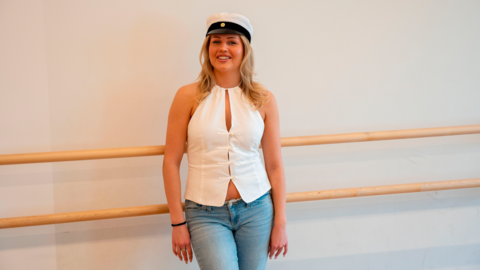
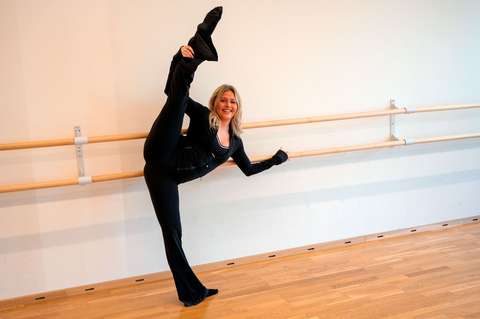
Anina Janatuinen graduated from the sports line of Haukilahden lukio upper secondary school. She praises the upper secondary school for the support she has received. After upper secondary school, Anina will focus fully on her career as a dancer.
Dancer Anina Janatuinen graduates from Haukilahden lukio upper secondary school. She is in fantastic spirits. "I had three good years in upper secondary school. I could not have hoped for a better school: I received good encouragement from the teachers and the principal when I had to be absent from my studies because of sports,” Anina says. She also feels relieved after upper secondary school because she is now able to invest even more in dance.
Before upper secondary school, Anina and her mother had considered general upper secondary education for adults as an alternative because it would have been even more flexible with the athlete's schedule. However, Anina wanted to go to upper secondary school and be with friends, so they chose day-time education. The location of Haukilahden lukio in the same city as her home and the dance school also contributed to her choice.
Anina praises the fact that athletes from so many different sports are admitted to Haukilahden lukio upper secondary school, enabling them to get to know each other and share experiences of the life of an athlete. Anina is pleased that the number of dancers has recently been increasing.
Athletes often have to travel so much because of their sport that they miss many of the upper secondary school traditions. Fortunately, this was not the case with Anina: “There was one dance assignment at the same time with the seniors’ ball, but I said no to it because I wanted to experience the seniors’ ball” she says. Anina and a few other girls who dance designed a dance of their own for the seniors.
Now she will concentrate on dancing
In upper secondary school, Anina found confidence and courage. In comprehensive school, she had made herself smaller because of bullying. During upper secondary school, she learned to make her own voice heard and not to think too much about the opinions of others.
Anina's favourite subject in upper secondary school was psychology. She says her teacher Pia Kuntanen was the best teacher. “It was wonderful to go to the lessons and I learned really well there. In the psychology lessons, the interaction between both the students and the teacher and between the students was good,” Anina describes. “If I ever continue my studies, I could choose psychology. Now I will focus on dance,” Anina adds.
Anina has been dancing ever since she learned to walk. Her mother enrolled her for lessons at Dance School DCA when Anina was very young (all of Anina's five siblings have also attended dance classes). "I really love dance. Dance is like a breath of fresh air to me. It has enabled me to express myself at difficult times,” Anina says. Anina’s dance competence is extremely broad. It includes show, modern dance, jazz, ballet, hip hop, commercial, contemporary and heels. “For example, Latin dances and breakdance are something I can’t do,” Anina laughs. She trains almost every day and teaches at Dance School DCA.
Anina has achieved a lot of success in dance. She has won gold and silver in the world championships in modern dance. However, now is the time to head away from competitions. Next summer, Anina will be working as Olga’s backup dancer. “Many doors do not open until when you are an adult. For example, you can get to work as a background dancer on gigs,” Anina says. Anina's to-do-list after upper secondary school includes a lot of training, dance work and more teaching hours.
Aiming for a career in dance abroad
Anina's big brother, Alex Komulainen, also alumnus of Haukilahden lukio upper secondary school, is pursuing a career in Los Angeles, and now her big sister is also aiming for it. Anina's goal is also to be able to dance in Los Angeles. However, matters such as visa issues are very challenging in the United States. Anina therefore sees London as a possible intermediate step.
Anina advises new students to listen to their own coping. "Don't push yourself too hard with the studies. Remember to take care of your social relationships,” she says. Anina points out that young people do not need to rush, and that everything is going to be ok.
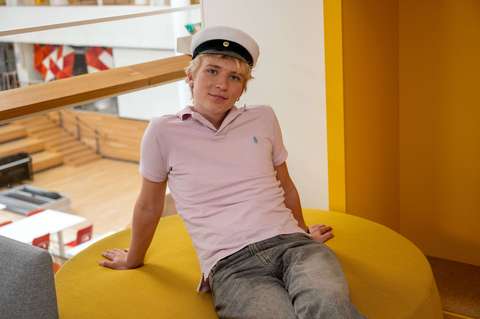
Ernesti Anttila graduated from the general line of Otaniemen lukio upper secondary school. His results were the best results in his upper secondary school this spring. According to him, good general knowledge and skills and groundwork on the courses helped him achieve excellent results. Ernesti won the Finnish Linguistics Olympiad this year and will participate in the international Olympiad in July.
Ernesti Anttila graduated from Otaniemen lukio upper secondary school. His results in the matriculation examination were the best results in his school this spring: magnificent 7 laudaturs and 3 eximias. "I haven’t quite realised I'm graduating, yet. I’m looking forward to university. I expect it to be different from upper secondary school,” Ernesti describes his feelings. He found upper secondary school a more liberal version of lower secondary school.
Originally, Ernesti wanted to take the test in seven subjects, but the teachers encouraged him to do three more. He comments on his excellent results in the following way: “Many things are easy when you have good general knowledge and keep yourself up to date.” He did good groundwork on the courses. It is important to be manage larger wholes: “You don’t need to know everything, not every single caption,” Ernesti points out.
"I have become more relaxed during upper secondary school"
Ernesti finds the seniors’ ball a really nice memory from upper secondary school. He got to dance twice, in his first year of study, and then again in his second year. However, his favourite things have been the ends of the schoolyears, when the weather has also been good.
Ernesti feels he has developed socially during his upper secondary school studies. “I have become more energetic and more relaxed,” he says. He is happy with his development himself. Overall, he is happy with his time in upper secondary school and would not do anything differently.
Success in the Linguistic Olympiad requires reasoning skills
In April this year, Ernesti won the final of the Finnish Linguistics Olympiad (KiOl). The Linguistics Olympiad (KiOl) is a science competition for upper secondary school students, organised with the aim of familiarising them with the global language situation and linguistic diversity. The assignments of 2026 had languages from three different language areas: Mexico, West Africa and the Great Lakes region in Central Africa. Last year, Ernesti came second, but won the competition this year. “The best part of the Linguistics Olympiad was the assignments. They were really nice. The assignments don’t require a lot of linguistic knowledge, but rather the ability to identify matters such as regularities and differences in different languages,” Ernesti says.
At the end of July, the four best competitors from the Finnish final will travel to the finals of the International Linguistics Olympiad in Bucharest, Romania. Last year, the international final was organised in Taipei, Taiwan. The trip is an experience itself as you might otherwise never travel to these destinations. The trip to the international final is free for the competitors.
Must take it easy
Ernesti’s future plans include graduating with a master of science degree in technology from Aalto University. “I haven’t decided the field yet,” Ernesti says. He has grown up in Otaniemi, and there are people with a master of science degree in technology in his family and among relatives.
Ernesti’s advice to those starting upper secondary school now is not to stress about things. “Take it easy. People are too conscientious," he says. His advice is also to try to make friends in upper secondary school. Friends are a resource that you can share experiences with.
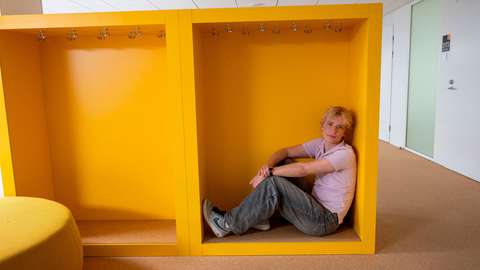
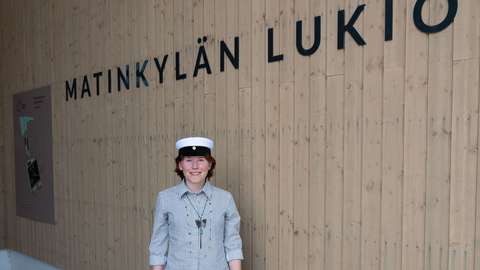
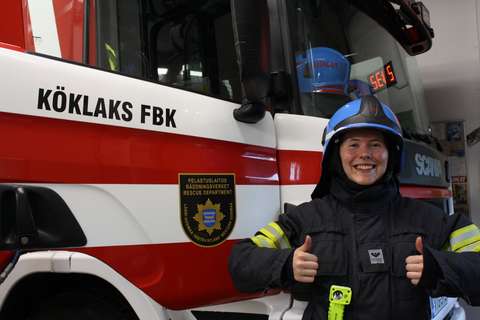
Petra Tähtinen from Matinkylän lukio upper secondary school graduated with the best results in her school. She praises the team spirit and opportunities for internationalisation in her upper secondary school. In her free time, Petra volunteers with a fire brigade. She advises others to have an open mind in upper secondary school.
Petra Tähtinen studied for the matriculation examination at Matinkylän lukio upper secondary school. Graduating makes her feel like a winner, but there is also a sense of melancholy: “These three years have been really nice. Now I feel a little bit sad because some of my friends will still continue studying and I will start further studies.” None of her friends from comprehensive school came to the same upper secondary school, but she has made a lot of new friends in Matinkylän lukio.
What Petra particularly remembers from her years in upper secondary school it the trip to Zimbabwe. The STEAM Circus project funded by the Finnish National Agency for Education was carried out in cooperation with Espoon yhteislyseo upper secondary school. Before the trip, the project group organised a children’s science festival at Matinkylä lukio, attracting a large number of children. At the festival, children had an opportunity to see magical science experiments, among other things.
On the trip to Zimbabwe, Petra learned to know a new culture and new people with her best friends. “We held different science-related workshops for local young people. The best moments during the trip were the encounters they had with different people and getting to know young people. “The culture there is so different from Finnish culture that it widened my world view,” Petra explains. Because Matinkylän lukio upper secondary school is a UNESCO school, the group also visited different UNESCO destinations in Zimbabwe. A Unesco school is a school that belongs to the global UNESCO Associated Schools Network (ASPnet). A Unesco School is an educational institution committed to promoting the values of peace, sustainable development and international understanding in its teaching and activities.
“It’s wonderful that your own upper secondary school provides opportunities for internationalisation,” Petra says. In addition to the trip to Zimbabwe, Petra also participated in an Erasmus+ project in Valencia, Spain, which focused on the links between the Baltic Sea and the Mediterranean. Workshops on topics related to the Baltic Sea were held for children of primary school age. An upper secondary school-specific Swedish course took Petra to the Åland Islands, where activities such as city orienteering challenged her to find the courage to speak to passers-by. In the lesson at the local upper secondary school, familiar topics in psychology helped her understand the teaching.
"I have learned to be myself"
Petra came to upper secondary school because she needed more time to think about what she wants to do when she grows up. “I liked the atmosphere and ambience at Matinkylän lukio,” Petra says. She praises the good team spirit and the nice teachers in the school. She has not regretted her choice of upper secondary school for a moment.
Petra’s favourite subjects in upper secondary school were psychology (“the best!”), mathematics and languages. Petra seems to have fallen in love with Spanish, in particular. She first started studying it on Duolingo when she was in grade 8 and at school in grade 9. In upper secondary school, she started Spanish in the spring of her first year. She has now surrounded herself with the language and learned a lot more: she browses social media in Spanish a lot, watches Spanish series and listens to music. Petra is also interested in French (7 years of studies in primary school). German is another language that Petra is interested in because the local contract fire brigade has a twinning friendship with a fire brigade in Germany. The fire brigade camps also attract a lot of young people from Germany.
Petra began to participate in volunteer fire brigade activities at the age of 9 together with his brother. They were both inspired by an event organised by the fire brigade. Her brother quit a few years later, but Petra’s enthusiasm has not dwindled. She has the competence required for participating in the emergency response activities of the volunteer fire brigade. She leads the youth department of Kauklahti VPK contract fire brigade and is responsible for the training for CTIF’s firefighting skills competitions. She also takes part in competitions herself: "This year, the World Firefighting Championships for young people are in the Czech Republic and for adults in Austria." When Petra started at the volunteer fire brigade, there were only a couple of other girls involved in the activities. Now the gender distribution has become considerably more even.
In addition to learning the subjects studied, a general upper secondary student also learns a lot as a person. "I have found the courage to be myself. I have also learned to do things that I am interested in myself even if they are different from the interests of other people,” Petra summarises. She has also learned to say no.
Continuing with the best results from her upper secondary school
Petra results from the matriculation examination were the best in Matinkylän koulu upper secondary school: her grades were 5 laudaturs and 2 eximias. Her results were excellent because she focused on learning during the courses. She says she can learn by listening and making notes, which has helped her save free time for a time-consuming hobby. “Listening during lessons and doing the assignments takes you a long way,” Petra points out.
In the spring joint application process, Petra applied to Aalto University’s Information Networks in the field of study of engineering. She says it has more to do with the humanities than many other fields of engineering. The multidisciplinary studies also make it possible to combine psychology, her favourite, with the studies.
For those who are just starting upper secondary school, Petra has a few pieces of advice: "Go and follow your interests with an open mind. It makes upper secondary school more interesting,” Petra says. She also advises everyone to be open to other people. "Be yourselves. Learn to say no. The only thing you shouldn’t say no to is the alarm clock,” Petra concludes.
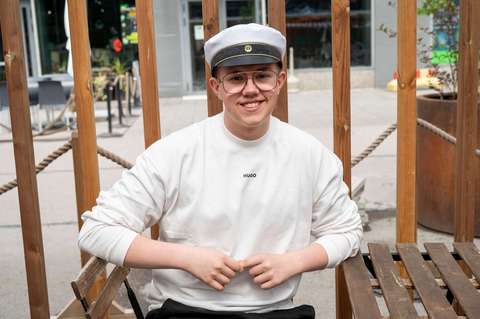
Noa Pohjasmäki studied in the visual arts line of Viherlaakson koulu upper secondary school. He is proud of his results in the matriculation examination. After upper secondary school, Noa intends to invest in his career in music.
Noa Pohjasmäki graduated from the visual arts line of Viherlaakson koulu upper secondary school. Now that he is graduating, he has mixed feelings because he has enjoyed upper secondary school. He describes his feelings as "wiskari-like": “Was this it?” (Like Arttu Wiskari sings in his song Tässäkö tää oli). Noa says he is happy and proud of himself because the matriculation examination also went well.
Noa got a laudatur from the test in religion in the matriculation examination. His goal was to get one laudatur on his certificate, and he worked hard for it. "When I started upper secondary school, getting a laudatur seemed impossible. I felt laudaturs were for swots only,” says Noa. However, he noticed that hard work pays off. Noa chose religion as his laudatur target, because the Christian faith is important to him.
The teachers were really good
Originally, Noa was going to apply to Espoon steinerkoulun lukio upper secondary school. He changed his mind when his best friend since pre-school years applied to Viherlaakson lukio upper secondary school and even to the visual arts line. Noa became interested in visual arts in lower secondary school, and art in general is something he has enjoyed. He praises Viherlaakson lukio for everything: “Everything there is the best: teachers, friends, the community, the milieu," Noa lists. Teachers in particular receive praise from him: “All the teachers in Viherlaakson lukio upper secondary school are simply amazing and really good. To me, they are examples of what a good teacher is like”, Noa says.
As his best memories from upper secondary school, Noa lists the three classic ones: the seniors’ ball, the “penkkarit” end-of-school celebration and AGT (the Abi goes Tallinn cruise).
Aiming for a career as a rap musician
Although has now completed the visual arts line in upper secondary school, Noa is more interested in music. “I did all the compulsory courses and even the general upper secondary diploma in visual arts, but I have focused on music,” Noa says. In music, his goal is to get to the top. Noa makes pop rap under the artist name NPEE. Although his journey in the Voice of Finland already ended in the ‘blind audition’ phase, it has not lessened his enthusiasm.
At home, Noa has a small studio where he makes his music. For example, he has participated in the Emma School, which is targeted at young people aged 16–29 living in Espoo and Helsinki who are interested in the music industry. The annual Emma School gives young people an opportunity to learn about the music industry and make music with professionals. A strong foundation in music is a good springboard: Noa’s family members are all musical. Until upper secondary school, Noa sang in the child and youth choir of the Espoo Cathedral Parish, but then switched from choir to rap.
In the spring joint application process, Noa applied to study for a bachelor's degree in business administration. Although his aim is a career as a musician, it is important to get an education. “My Dad has a bachelor's degree in business administration himself and said that you can find employment in any field if you have that education,” says Noa. Knowledge of business management is also necessary in the music industry, where a lot of marketing and business activity of one's own are required.
Daring is important
In upper secondary school, Noa learned three things as a person and advises those who are just starting upper secondary school to learn the same: "Work hard. Be yourself. The world is for those who dare." Noa places special emphasis on daring. It is what he needs in music, in particular. "If I want to be a musician, I have to dare to get on the stage. I won’t get anywhere if I don’t dare,” Noa says. Looking at him now, it is a little hard to believe that he has been very shy and introverted. Noa did his own thing, even though he faced criticism. Of course, he was reflecting whether it was worth doing his own thing or not when what he did was criticised. Noa chose his own way.
In the graduation ceremony, the school will award Noa a Pro Musica medal and a diploma. They are given on application to a graduating student as a recognition for having demonstrated musical talent and interest in music in their upper secondary school studies when the student has actively participated in the school’s music activities.
Listen to Noa's music on Spotify: NPEE(external link, opens in a new window)
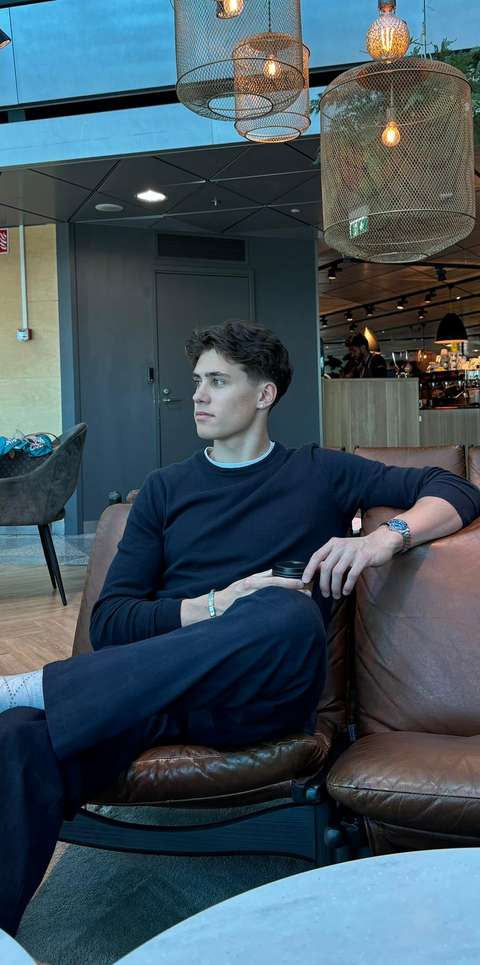
Leo Gumpinger graduated from Etelä-Tapiolan lukio upper secondary school. His favourite memories from upper secondary school are the study trips abroad. Leo also praises the internationalisation of the upper secondary school in general. He recommends completing a language diploma to others, too.
Leo Gumpinger graduates from Etelä-Tapiolan lukio upper secondary school. Graduating gives him a strong sense of change: "All of a sudden, there’s a lot more freedom. The life situation has changed, but I have not changed so much as a person,” Leo says. He has mixed feelings about it: the future seems to be close in front of me, but I don’t know what it will look like. “It brings a certain kind of curiosity and, at the same time, also some unclarity – not in a bad but in an exciting way,” Leo describes.
Leo highlights the study trips to Austria with the group from the German lessons and to Geneva to the CERN research institute and particle accelerator with a small physics group as the "coolest" experiences during upper secondary school. “On the trip to Geneva, we could focus on topics whose surface was only scratched in upper secondary school and saw how they are applied in practice.” He also liked the opportunity to experience the trips with friends and enjoy studying abroad.
Leo says he was actively involved in the activities of the upper secondary school during his studies, even though he did not have any official role, such as a tutor. For example, he was happy to help if events were organised in the school. “I liked the atmosphere in our upper secondary school and wanted to make a positive contribution to it. I wanted to set an example to others: when everyone does their best, we can achieve much more as an upper secondary school and as a community,” Leo explains.
Upper secondary school taught the importance of routines and internal motivation
Upper secondary school forced Leo to create routines and taught him the importance of routines when he had a lot of schoolwork and also much to do in his free time. Upper secondary school taught Leo that certain things must be automated in everyday life. They become routines and that's when things get done.
If Leo could turn the time back to the beginning of upper secondary school, he would pay special attention to scheduling things and time management. He says that the importance of using a diary was emphasised a great deal from the very beginning of upper secondary school. “It wasn’t until the last year in upper secondary school began that I realised how vital the diary is. If I had been able to use a diary right from the beginning of upper secondary school, I would have been spared unnecessary stress and trouble. Schoolwork would have generally felt lighter.” Leo points out that even if the diary does not seem useful when it is empty, using it is a good habit.
When he started upper secondary school, Leo's idea of what his life and career would look like in the future was narrower than today. The amount of work in upper secondary school and studying topics in more depth taught him that when you work hard on something, you have to be passionate about it. If you do not feel passionate about the subject of your studies or about your work, it will consume you significantly more. This taught Leo that whatever he will aim for in the future, his choice must based on internal motivation and interest – work and studying may then be fun.
In Leo’s opinion, the teachers at Etelä-Tapiolan lukio upper secondary school knew how to make topics interesting. His favourite subjects were mother tongue and physics. “I was interested in mother tongue because I understood the significance of my own expression skills in upper secondary school – expressing my thoughts both in writing and orally. Small nuances in language use may lead to big differences,” Leo explains. This made mother tongue an interesting subject. He felt that good self-expression skills would be very useful and a very strong tool in later life. Leo liked physics because he has always been interested in technology. In physics, you get to work with technology a lot and apply mathematics in practice. “It was really interesting and rewarding,” Leo sums up.
A language diploma opens up many opportunities
In Leo’s opinion, the best thing about Etelä-Tapiolan lukio upper secondary school was internationalisation. “At Etis, I met a lot of people from different cultural backgrounds, which expanded my own mindset and made school really interesting,” he explains. “There were many people at school who were from different parts of the world, but shared experiences that you could identify with, such as being multilingual and having dual citizenship. I’m sure that the contacts I made at Etis will bring a great deal of joy and benefit in the future as well,” Leo says with satisfaction.
Leo's other mother tongue is German. During upper secondary school, he completed both of the two Sprachdiploms, which are official German language examinations offered by the German state. The diploma measures four different areas: reading comprehension, listening comprehension, writing and oral language skills. “I have always spoken and studied German, so it was natural to also get proof that I really do know German,” Leo says. Leo admits that it was really easy to complete the actual test for the diploma because of his native skills in German. However, the German teacher required him to work for the diploma. “I had thought that I would get far with my language proficiency, but the Diploma required work and preparation,” Leo admits.
Leo definitely recommends completing a language diploma. The Sprachdiplom will be valuable in the future. For example, it makes it easier to complete a study exchange or work in a German-speaking country. Leo points out that employers may often have concerns about whether the applicant’s language skills are sufficient. The language diploma can be used to prove this. “Today, artificial intelligence and technology make it possible to translate languages in real time. However, this does not make language proficiency less important. People will always need genuine face-to-face contacts because they reflect trust. Good language skills will always help to create important relationships of trust in the future. Language skills make the world significantly smaller for me and open the doors to Central Europe,” Leo says.
A graduation song of his own
According to Elina Oja, Assistant Principal of Etelä-Tapiolan lukio upper secondary school, Leo is a talented musician. Leo has indeed played at many events at his upper secondary school. He has made a song for the graduation ceremony, but the song will not be revealed until the day of the ceremony. “When I was making the song, I thought about how it feels to move on from upper secondary school. I can tell you that it begins with an intro resembling the Suvivirsi hymn combined with rock. The graduation song is a funny song with which we will definitely have fun with friends,” Leo says.
In his free time, Leo often produces house music. “R&B and jazzy rap beats are what I like to do on my own or with friends,” he says. With his band, Leo makes pop rock-style music. He has a long history of engaging in music, starting from the music playschool.
From upper secondary school graduate to fighter pilot
It is time for the upper secondary school graduate to consider his future plans. Aviation has always been close to Leo's heart. "I have applied for the Pilot Reserve Officer Course. Over the past few years, the idea has developed that I would like to become a military pilot. It is my dream to be able to fly fighter planes,” Leo says. If he does not become a pilot, Leo might graduate with “some kind of master of science degree in technology”. In the spring joint application process, he applied to Aalto University to study industrial engineering and management. Leo is also interested in studying mechanical engineering or some kind of aerodynamics. “Everything that moves fast and quickly has always been close to my heart. It would be wonderful to also work with such things,” Leo adds.
Finally, it is time to give some advice to future upper secondary students. Finding it difficult to summarise everything in one piece of advice, Leo gives three points, like President Alexander Stubb:
1. Surround yourself with people who are interesting and smart. "I have noticed that I'm the sum of the people I spend time with most." According to Leo, it is a good idea to boldly get to know different kinds of people in upper secondary school. Different people bring perspectives that you may not think of yourself.
2. Passion is very important. “When you go to upper secondary school, do not settle for any spare options that are the easiest ones from the point of view of future career opportunities and money. Life with a career like that may not be so enjoyable,” says Leo. “Pursue what you are interested in, even if it’s a slightly different career path or a different field compared to other people,” Leo advises.
3. Health must always come first. “The workload in upper secondary school can become extremely heavy, and stress will accumulate. However, it must not become so much that your physical or mental health suffers,” says Leo. His advice is to always invest in physical health: “As long as your physical health is good, it will be much easier to concentrate and study. Remember to do sports regularly and do things that make you happy,” Leo says.
Listen to Leo's mucis on Spotify(external link, opens in a new window) or on Instagram(external link, opens in a new window)