The demolition of the old Pohjois-Tapiolan koulu school building served as a platform for experimenting with reuse
The old, red brick Pohjois-Tapiolan koulu school was demolished last year. We practiced more sustainable operating methods in connection with its demolition. We succeeded in selling fixed furniture and removing and cleaning the bricks intact, paving the way forward.

New operating methods are needed to increase the reuse of construction products
Construction and demolition account for over 30% of global greenhouse gas emissions. At the same time, the lack of resources and the emphasis on self-sufficiency are hot topics around the world. The materials of demolished buildings are already recycled fairly efficiently, but recovering materials intact and reusing construction products in renovation and new construction is still new in Finland. Promoting reuse does not require much investment, but learning new things and changes to existing planning processes are necessary. Pilots are an opportunity to experiment with new operating methods at a low threshold and to learn about establishing and expanding the circular economy.
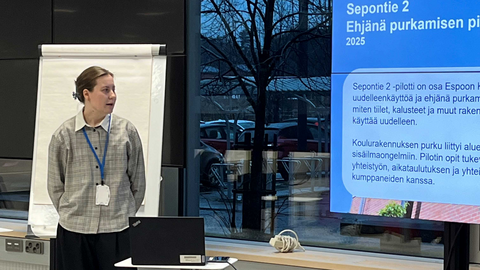
Espoo wanted to pilot reuse at a suitable demolition site in spring 2025. The old Pohjois-Tapiolan koulu school, built in 1964, had been ordered to be demolished due to the increased need for space and high renovation costs, and it was selected for the pilot.
The pilot partners included Metropolia University of Applied Sciences, Spolia Design Oy that specialises in the reuse of construction products, the recycling operator Risain Oy that promotes reuse, and the demolition contractor Purkupiha Oy.
The pilot gave a new life to bricks and furniture
For the first time at a demolition site of our own, we tried recovering bricks from the building’s façade intact, cleaning them, and selling fixed furniture to third parties for further use. We succeeded on both fronts.
The work began with an inventory of reuse. Summer workers hired by the city determined the number of bricks in the façade. A batch of bricks was first submitted for examination, where they were found to be suitable for further use. After this, professionals from Spolia Design Oy cleaned the agreed-on number of bricks on site. The bricks were recovered intact by Purkupiha. Now they are neatly packed in a warehouse, waiting for the city to launch a suitable renovation or construction project.
The city already has a well-established practice for reusing loose furniture; over a thousand pieces of furniture are repaired and transferred from one unit to another every year. This is not the case with fixed furniture, not yet at least, and furniture has been sold outside the city only occasionally.
In the old Pohjois-Tapiolan koulu school, the recycling operator Risain first inventoried the furniture on the property together with Metropolia students. Usable construction products were sold by publishing advertisements on the Kiertonet public-sector online auction website. The products sold well, and the buyers retrieved them personally from the school on the agreed-on days. Used items were sold to offices, homes and cottages alike. Read more about experiences on the Pohjois-Tapiola pilot in our summer employee’s blog post.
Emission reductions and other benefits
One of the goals of the pilot was to collect data on the benefits of reuse. The pilot was implemented on a tight schedule before the demolition began, and the results are good considering this fact. Buyers were clearly interested in the loose furniture and building elements of the school.
“We are accumulating experience and learning for the future,” summarised Structural Manager Vesa Pyy from the City of Espoo Premises Department already at the kick-off meeting.
Without the city’s intent and effective cooperation, the interior doors, coat racks and fixed furniture, gym equipment and canteen and kitchen furniture still in good condition would have ended up in recycling as part in the course of the demolition.
According to Risain’s report, the carbon handprint generated by selling the furniture, i.e., the amount of emissions avoided by taking action, was over 30,000 kilograms of carbon equivalent. And this figure does not include the furniture that the city reserved for its own use before the public sale. Selling fixed furniture has a surprisingly significant impact, as fixed furniture is typically more complex, heavier or more valuable than loose furniture (e.g., kitchen appliances or heavy, soundproofed interior doors).
The carbon handprint generated by reusing fixed furniture in the pilot is larger than the combined annual carbon footprints of three Finns. This figure is comparable to the annual emissions from over nine electric-heated single-family houses or to 376,000 kilometres driven by car (approximately the distance between the Earth and the Moon). Five return flights to New York would generate approximately the same amount of emissions.
More detailed information on the planning and implementation phases of the furniture pilot, the commercial perspective and the calculation of climate impacts (the carbon handprint) are available in the final report attached to this article.
Emission reductions from reusing bricks are also significant. There are approximately 60,000 bricks in a building the size of the Pohjois-Tapiolan koulu school. If half of these were to be reused, CO2 emissions would be reduced by almost 15 tonnes. This figure corresponds to approximately one and a half years of electricity consumption by a medium-sized household or to driving around the globe twice. In the pilot, more than 5,000 bricks were cleaned. The amount of reduced emissions corresponds to flying to New York and then driving to Los Angeles on the other side of the continent.
Reusing furniture also positively affects costs. It is estimated that the recycling costs avoided through the reuse of furniture would have ranged from around five hundred euros to two thousand euros, depending on how carefully the waste would have been sorted. Selling the furniture yielded around 7,000 euros. When sales operations are procured as a service, the price, cost benefits and revenue of the service are allocated to the actors as agreed. If planning and sales are initiated early, it is more likely that the products are sold at a good price.
Reused products also have sentimental value. The buyers appreciated the history of the products, and former pupils of the old Pohjois-Tapiolan koulu school were among the buyers.
Vandalism as a challenge
The school building that was waiting to be demolished had been subjected to vandalism over the years, and the same applied during the pilot. Fortunately, most of the furniture in the school remained in good condition, even though unauthorised visitors had accessed the premises. The school was used by property maintenance staff while decommissioned, which contributed to curbing vandalism.
A few sales of used products had to be cancelled because the product had been broken or destroyed before it could be sold. The duration of the public sale was also kept as short as possible due to the threat of vandalism.
Bricks with graffiti were left to waste management. Cleaning them would have been far too laborious. Fortunately, there were only a few of them.

Better demolition technology and more proactive scheduling would contribute to a more efficient reuse process
The pilots in the old Pohjois-Tapiolan koulu school showed that reuse is beneficial for the environment, and that it has economic and social value. Encouraging examples from similar pilots are needed for the practice to become more commonplace. Some practical challenges also remain unsolved.
In most cases, dismantled bricks still end up as construction waste in Finland. However, there is a great deal of potential for reuse and there would be demand for bricks as long as the price is competitive compared to new bricks.
Enabling the reuse of bricks is not efficient enough yet. In Pohjois-Tapiola, the bricks were recovered with a normal demolition grapple. Removing them is quick, but around half of the bricks fall and break. A grapple intended to recover the bricks intact could have one straight side, and the sides of the grapple could be closed to prevent the bricks from falling. The breaking of bricks is not only a problem because of waste, but it also increases the time required for sorting the bricks. Various ideas for accelerating the cleaning process by means of different solutions related to the order of work stages and the outfitting of the cleaning station also emerged in the pilot. Read more about the implementation of the brick reuse pilot in the final report at the end of this article.
Scheduling emerged as the greatest challenge in reusing furniture. Due to the short duration of the pilot, there was too little time for communication and marketing. The results of the sales were lower than in ideal circumstances, and someone could have missed the find of their life. In the future, reuse surveys and sales of furniture should be carried out immediately after the use of the facility ends.
“In the future, the implementation of reuse should be carried out well before the tendering of the demolition contract. This way, there would be more time for internal transfers within the city as well,” states Sirpa Rivinoja from Risain Oy.
The need for new types of partners is also new in this process. Traditionally, demolition has been fairly straightforward after obtaining a demolition permit, and the work has been ordered from a demolition company under the existing framework agreement. Now, reuse companies and students were also involved in the cooperation. New requirements must be taken into consideration in future procurement and demolition planning.
Reuse pilots to be continued in 2026
We will continue conducting reuse pilots, accelerated by the joint Circular Buildings project by the municipalities in the Helsinki Metropolitan Area and Helsinki Region Environmental Services Authority (HSY), co-funded by the EU. We will develop operating models for the reuse of load-bearing structures together with our experts at the Premises Department in spring 2026, and we will select reusable building elements from buildings to be demolished in the next few years to create a type of building that can be used as an outbuilding of a day-care centre or school, for example. We will publish the results of these pilots in early autumn.
Downloadable files
- Uudelleenkäyttöraportti (3.0), Sepontie 2, elokuu 2025, Risain Oy.pdfFile is only available in Finnish
- Sepontie tiilien puhdistamisen selvitys_Spolia Design_251013.pdfFile is only available in Finnish