Reuse of building elements - Winners of the Helsinki Metropolitan Area’s joint innovation challenge selected
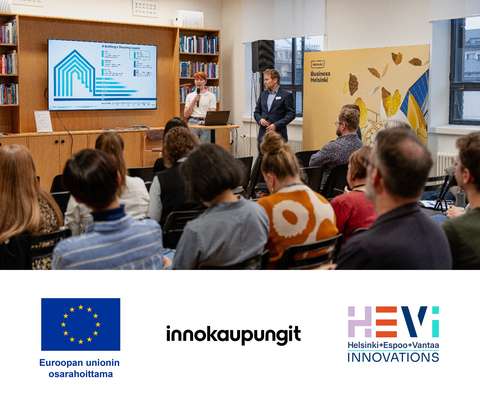
What if it were possible for bricks, concrete elements, and other building elements from demolished buildings to gain a new life at a new construction site? Espoo sought innovative solutions for the reuse of building elements in the Circular Buildings innovation challenge implemented in cooperation with Helsinki, Vantaa, and the Helsinki Region Environmental Services Authority (HSY). The finalists got the opportunity to present their solutions and the jury selected the winners at the Demo Day on 21 November 2025. In Espoo, spring pilots will be carried out together with Ramboll Finland Oy and Lundén Architecture Oy. The pilots will include work to develop operating models for the reuse of load-bearing structures, digital solutions used in mapping the reuse of demolition sites, and the formulation of a model for type building, such as a shelter or storage building, in which undamaged materials from buildings to be demolished can be utilised. The aim is to reduce emissions, save natural resources, and create new operating models that make the circular economy a common part of everyday life.
Winners of the innovation challenge impressed with their innovativeness and impact
- Winners of the innovation challenge impressed with their innovativeness and impact
The Circular Buildings joint innovation challenge in the Helsinki Metropolitan Area invited companies to develop concrete solutions for demolition, the reuse of building components and the extension of the life cycle of buildings. Espoo’s challenges sought solutions that promote the utilisation of building components at demolition sites in new construction and renovation construction.
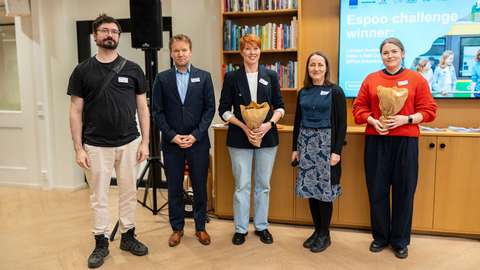
The winners of the Espoo innovation challenge were Ramboll Finland Oy and Lundén Architecture Oy. Congratulations to the winners!
The aim of the Espoo pilots is to:
- find ways to reduce emissions from construction and create new business in the reuse sector.
- develop the municipality’s own processes in line with the circular economy.
- share the lessons learned and the results openly with other municipalities and actors.
“The winning solutions stood out due their impact, innovativeness, and feasibility – they provide a model for seeing the sites to be demolished as valuable resource banks, not just as recyclable material or waste. It was also important to us that the pilots allow us to learn and accumulate our own reuse expertise during them,” says Tiia Tuuri, Project Manager for the Circular Buildings project.
Pilots support reuse planning and the development of digital solutions
The pilot offered by Lunden Architecture Oy with its partners focuses on forming a data model-based building component catalogue of the buildings to be demolished and utilising this in the design in a building type that can replicated, such as a shelter or storage building. Architects from Make a BIM and studio MPRA developed a digital process and information management model during the previous innovation challenge by the Helsinki Circular Economy Cluster, which serves as a technological starting point for the work. The process is scalable and will in the future allow for expanding reuse from small structures to large construction projects. The concept responds to the objective for creating demand for reused parts and provides an innovative approach to the building stock to be demolished. Espoo is also interested in the opportunity offered by the pilot for developing information models as a tool for the circular economy.
Ramboll Finland Oy’s pilot focuses on the reuse of load-bearing structures that are significant in terms of climate emissions. The pilot will promote the formation of information on the reuse potential of the load-bearing structures from demolition sites. The information will be formed gradually becoming more specific as demolition proceeds. The functionality and adequacy of the mapped information will be tested in the pilot with the designers during joint reuse workshops, especially from the perspective of the initial information needs of the architect and structural designer. During the pilot, Ramboll will also develop its own AI-based digital solution. The pilot supports the development of the City of Espoo’s own competence and operating models. The resulting operating model for reuse can also be scaled to other municipalities.
Four solutions in the final, each of which plays an important role in the reuse of building elements
We received seven good tenders to our invitation to tender. Based on a comparison of the tenders, four companies were selected to present their solutions during the final (Demo Day) presentation, each of which approached reuse from a different perspective. In addition to the winners, Ramboll and Lunden, A-insinöörit, Suunnittelu Oy and Spolia Design Oy held presentations on their solutions at Demo Day.
“All the solutions were good and all of these are needed. The choice was a difficult one, and we had a long discussion when comparing the solutions. We selected the options that combined innovation and impact from the perspective of the entire sector and the needs to develop our own activities as a city,” described Reeta Lehto, Project Manager at the Premises Department. The members of the Espoo jury included Structural Engineer Marjut Mõttus and Reeta Lehto from Planning Services and Project Development Manager Sanna Reunanen from Construction Services, Development Manager Tiia Tuuri from the Centre of Excellence for Sustainable Development and external expert and business representative Life Cycle Project Manager Jani Kuivamäki from SRV. “I hope that the other solutions that made it to the final will also have the opportunity to progress in the future in addition to the currently selected pilots,” says Tiia Tuuri, Project Manager for the Circular Buildings project.
In cooperation with their partner, A-Insinöörit offered a solution that develops an operating model for the management, measurement, and decision-making support related to the reuse of building elements, using the digital Loopfront platform, which is already used by several operators in Norway. The aim of the pilot was to map, document, and guide the parts to be dismantled and suitable for reuse from the demolition sites to internal or external circulation. The Loopfront platform also enables maintaining a digital inventory, marketplace, reporting and automatic carbon dioxide emissions and cost savings calculations.
Spolia Design Oy’s pilot focused on developing methods for enhancing the intact removal of bricks at demolition sites and promoting their cost-effective reuse. The main focus of the pilot was on creating an operating model and method recommendation for reducing material loss and shortening the processing time of bricks from dismantling to a cleaned product. At the moment, the removal and cleaning of bricks requires a great deal of manual work. The aim of development work is to reduce costs and speed up the cleaning process in order to make reuse profitable and to ensure that the price of reused bricks is more competitive than that of new bricks.
Espoo piloted the undamaged dismantling of bricks and the sale of fixed furniture for reuse at the old school in Northern Tapiola last spring. The solutions proposed by A-Insinöörit and Spolia corresponded precisely to the needs we identified in the pilot. Digital data collection and information dissemination on dismantled sites both internally and to other actors is essential to promote re-use and commercialise re-used products. The greatest factor slowing down the reuse of bricks at the moment is the cost of dismantling buildings while keeping bricks intact and cleaning them.
Pilots support the objectives of the Espoo Story
The Espoo Story is guiding the city's strategy towards a carbon-neutral future. The reuse of building elements supports in particular the objective of promoting the circular economy in construction and reducing emissions. By increasing the circular economy, we also save natural resources, strengthen self-sufficiency and promote local employment.
“Espoo is Finland’s innovation hub, and we want to strengthen sustainable growth, especially through the green transition, technology, and creative industries. Innovation challenges and piloting are excellent ways to learn new things and put new solutions into practice together,” says Reetta Jänis, Development Manager.
Cooperation takes place throughout the Helsinki Region
The innovation challenge is part of the joint Circular Buildings project undertaken by the cities of Espoo, Helsinki, and Vantaa and HSY. HSY supports the project by producing data on topics such as the environmental benefits of new solutions. The Circular Buildings project(external link, opens in a new window) promotes the transition of the Helsinki Region’s construction and real estate sector towards a carbon-neutral circular economy. The objective of the project is to support the creation of sustainable and circular solutions while promoting as efficient use of the existing building stock as possible. Its aim is to keep the natural resources used in the existing building stock in circulation for as long as possible, both by extending the life cycle of the buildings and by promoting the reuse of the materials generated during demolition. The project is co-financed by the EU. For more information on the implementation of the innovation challenge, please see the project website(external link, opens in a new window).