The City of Espoo receives an honourable mention for the Landscape Architecture Act of the Year
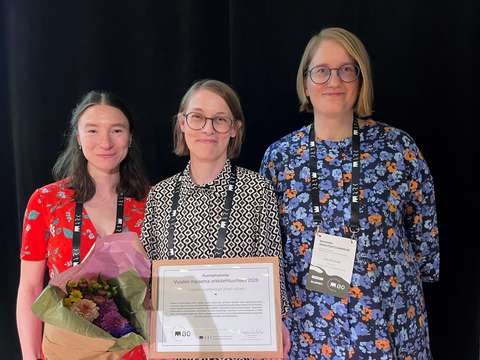
The Finnish Association of Landscape Architects MARK awarded the Espoo City Planning Department and the Environment and Building Control Department an honourable mention for the Landscape Architecture Act of the Year. The Landscape Architecture Act of the Year was awarded to the City of Jyväskylä for the restoration of Tourujoki River. The winners were announced on 2 October 2026 at the Landscape Architecture Day, which was organised to celebrate the 80th anniversary of the Finnish Association of Landscape Architects MARK.
An honourable mention was awarded for the long-term work carried out in Espoo to develop home gardens to support biodiversity. The City of Espoo has introduced a dedicated nature calculator to the Green Factor Tool, as well as published and shared information on how residents can enhance greenery and biodiversity of their gardens with property managers, developers and ordinary residents alike. The work done by the City of Espoo shows that even small choices made on private plots have a major impact on the functioning of the ecological network, and that a combination of guidance, indicators and examples is an effective way to change practices.
At best, home gardens can be an important part of diverse urban nature, while supporting the well-being of residents as green oases in the city. The honourable mention highlights the scalability of the project: the model can be applied in other municipalities and encourages looking at the city as a whole to halt biodiversity loss.
The Landscape Architecture Act of the Year is an annual award of recognition that aims to highlight Finnish landscape architecture or actions that have promoted its visibility and appreciation. The purpose of the award is to promote landscape architecture and its appreciation in Finland and the success of Finnish landscape architecture in the world.
Espoo works hard to promote biodiversity
In 2024, Espoo introduced the Green Factor Tool, which was the first in Finland to include a separate nature calculator. In the green factor tools previously in use, biodiversity was mainly considered in so-called bonus elements, the application of which has been voluntary.
“In Espoo, we understood that nature in home gardens is more than just a bonus. The nature calculator can be used to guide urban green in a direction that supports species and the preservation of their habitats. The nature calculator also serves as a checklist guiding planning choices in actions that support biodiversity in home gardens,” says Aino Leskinen, landscape architect at the City Planning Department.
There is also growing concern in Espoo about the prevailing construction method where, almost without exception, existing trees are felled from the site before construction begins. In 2025, Espoo published a brochure and website for builders, property managers and residents called Stand by your tree. The aim is to highlight how each party, through their own actions, can influence the preservation of natural and lush yards also in the future.
More than 50 gardens participated in the garden competition organised in summer 2026
As a continuation of these activities, the Espoo's Nature-Wise Gardens competition was organised in 2026. The aim of the competition was to collect information and examples of how biodiversity and climate change adaptation are promoted in home gardens. Essi Ehrnrooth, landscape architect at the City Planning Department, says that the results of the competition show that home gardens have a huge, largely untapped, potential as part of urban nature.
On a large, detached house plot, the space and the form of management of the plot provide better opportunities for developing the garden in a nature-wise direction and making the right choices for biodiversity, in both the care of the garden and the planning solutions. In a small garden, choices to promote biodiversity require more work, planning and resourcefulness. Nature-wise solutions implemented in the courtyard of an apartment building are often visible and benefit more people. By making the right determined choices, even a small garden and the common courtyard of a housing company can support biodiversity and achieve a green surface area and biodiversity values that are many times higher than today's green factor objectives.
An individual garden may seem like a small unit in the urban structure. However, the gardens form a huge network and green potential in the urban structure, which can be endlessly developed as a platform for diversity. According to Leskinen and Ehrnrooth, the analysis of the example gardens lays the foundation for good planning at the level of local detailed planning and building control. It also guides owners of built plots and blocks across the entire city to develop their yards to be more nature-wise.