One lesson, a visible impact: schoolchildren removed invasive species from Espoo’s parks
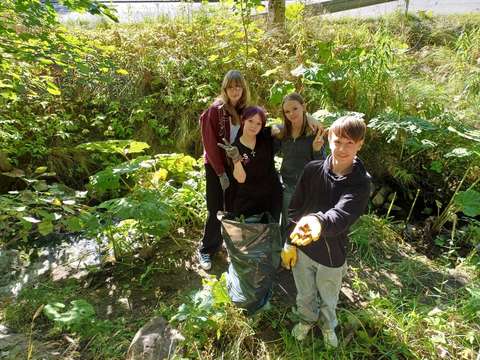
On sunny August mornings, eighth-graders from Mainingin koulu left the classroom behind and ventured into their local nature to remove invasive species. At the same time, they learned to identify harmful species and discovered practical ways to improve the wellbeing of their local environment. Pupils said that working outdoors was both fun and rewarding, as they could immediately see the results of their efforts.
Classes 8A and 8B from Mainingin koulu went out with their biology and geography teacher Iivari Laakkonen to remove invasive species from the nearby Ankkuripohjanpuisto park and the area around Espoo Mini-Golf. They brought all the necessary equipment, including waste bags, gardening gloves and plastic bags.
The plants they removed were giant knotweed and butterbur. They also found Spanish slugs. The slugs were killed and placed in a plastic bag, which the teacher then delivered to the appropriate location for further disposal.
For five years now, Laakkonen has involved his classes in removing invasive species.
“This is an easy and concrete way to implement the objectives of the curriculum, such as providing pupils with opportunities to participate and have an impact, taking care of our shared local environment, and promoting a sustainable way of life. The pupils have also been excited about activities outside the classroom,” Laakkonen says.
“Although we often talk about planting trees, we rarely actually get around to it. Removing invasive species in the school’s surroundings is a low-threshold activity, even for pupils who do not usually spend time in nature. Pupils can see the impact of their work immediately, rather than years later. Even though one class cannot clear a very large area during a single lesson, you can still see the difference when a smaller area is cleared of invasive species. When several classes work together, they can accomplish even more,” Laakkonen continues.
The best time for removing invasive species would be June and July, when the children are on their summer holiday. It therefore makes sense to schedule the activity for August and September, immediately after school starts, when the work can still have an impact.
“When annual plants are removed all at once, they are less likely to grow back in the same place. At the same time, pupils learn to identify plants and understand that if they encounter these species in their own surroundings, they can remove them,” Laakkonen explains.
“This is more fun than I thought!”
The pupils said that removing the plants was fun, although various bugs, such as ants and slugs, were a little disgusting. They also enjoyed being able to help and do something for the common good. They would be happy to come back and remove plants again, but they would prefer species that are easier to remove than butterbur, which is large and firmly rooted in the ground.

Both the teacher and the pupils considered the experience a great success. The pupils felt that removing invasive species was more enjoyable than ordinary classroom lessons, and many were pleasantly surprised to see the visible results of their work. As proof, we heard delighted comments from class 8A pupils about how much they accomplished in a short time.
The city’s efficient cooperation also received praise: the city’s green area maintenance team collects bags filled with plant waste from the locations reported by the people who removed the plants. This makes it easier for people to take action, as they do not have to find a place to dispose of the plant waste or carry heavy waste bags around.