Children voiced their perceptions of leisure time in a Kid Dialogue at Lintulaakson koulu school
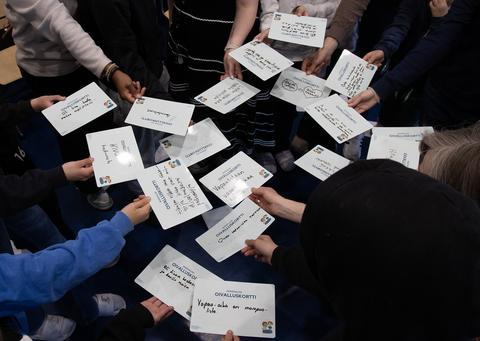
A Kid Dialogue discussion on leisure time was organised at Lintulaakson koulu school. The participants were 5th and 6th-graders, teachers and employees from the Espoo Hobby Path. In the dialogue, children and adults had an opportunity to listen to each other and form a shared understanding of how leisure time is perceived.
During leisure time, we can do the things that we want to. This is a good way to summarise one of the insights from the Kid Dialogue held at Lintulaakson koulu school.
Kid Dialogue is a model for constructive discussion based on the Timeout dialogue. The aim of Kid Dialogue is to hear different ideas on the topic discussed and to increase a shared understanding. At Lintulaakson koulu school, 5th and 6th-graders, teachers and staff from the Espoo Hobby Path participated in the dialogue.
“Children and adults were sitting in the same circle. The children were of different ages and from different grades, which often provides the discussion with more versatile perspectives,” says Petra Larvus from the Timeout Foundation. She facilitated the dialogue and has been developing the Kid Dialogue model.
In the dialogue held at Lintulaakson koulu school, the participants reflected together on what leisure time is and what makes leisure time good. The versatility of leisure time was considered important. On the other hand, the strain caused by leisure time was also highlighted in the dialogue. What the participants valued in leisure time was both the time spent with their family and friends and the opportunity to be on one's own.
Many of the participants found the dialogue meaningful and thought it was nice to hear the opinions of the other participants. According to Larvus, the benefits of the model include the promotion of discussion skills and, above all, the opportunity to practise them, to increase one’s own and a shared understanding, and to influence one’s own life. Larvus says it was wonderful to see how even the quieter participants found the courage to share their thoughts with the others as the dialogue progressed.
“Kid Dialogue is a vantage point for both children and adults to hear each other. A shared dialogue increases a shared understanding and improves opportunities to discover new insights that may otherwise remain hidden,” says Larvus.
Kid Dialogue can be used in the development of services to form an understanding of how children and young people perceive the topic discussed. Senior Specialist Kimmo Sillanmikko from the Espoo Hobby Path, who participated in the dialogue, was listening to the insights carefully.
“A dialogue is a good tool when we want to understand how children and young people experience things and to increase interaction between generations. Children and young people have a great deal of views on their leisure time and hobbies, and it is important to enable them to verbalise their experiences and participate in the discussion. It is also good to have adults with different professional backgrounds in the same discussion,” says Sillanmikko.
The aim is to organise more Kid Dialogues on the themes of leisure time and hobbies in Espoo. The dialogues are planned and organised in cooperation with schools.