Literacy is the foundation of well-being and learning
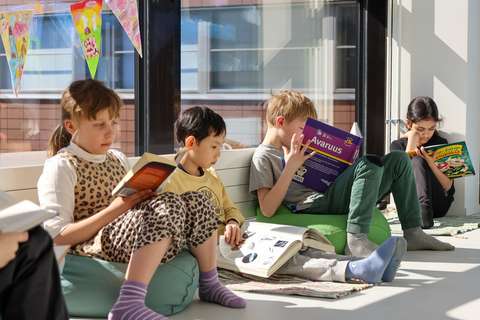
On Espoo’s learning path, literacy work is done from early childhood education all the way to upper secondary education. Children’s and young people’s literacy is strengthened in everyday life in many ways. Literacy work is not limited to the walls of a classroom or group room, but literacy can be practiced, in addition to reading, also by moving in nature, exploring, listening or singing together. The goal is that every child in Espoo learns Finnish or Swedish well and experiences the joy of reading also in their free time.
Literacy work can be done in many ways. Reading aloud is one of the most effective ways to support the development of literacy and to spark interest in books. Listening strengthens literacy because it supports language development, expands vocabulary, deepens understanding and increases motivation to read. Listening to a story requires long-term concentration and thus develops the ability to concentrate also on written text. Listening and reading are skills that support each other and help build a strong linguistic foundation.
At Mankkaan päiväkoti, literacy work is done through play
In the nature group of Mankkaan päiväkoti, reading and reciting rhymes together takes place every day. Cheerful voices echo also in the forest where the children of the nature group and early childhood education teacher Tarja Hoffström spend time three mornings a week.
“In our group we read stories both in small groups and together as a whole group. We read nature-themed stories in the forest that we have illustrated because the stories contain a lot of descriptive language. Alongside and after reading the stories we discuss the plot and go through the pictures. We also always have nature-themed books with us. From them we look for information on topics that interest the children”, says early childhood education teacher Tarja Hoffström.
The group reads stories always before meals. At the moment, they are reading Vahvuusvariksen tarinat. With the help of the stories, it is easy to discuss many topics with the children and the children learn to put their feelings and strengths into words through them. Rhyming is used for example in waiting situations both in the forest and indoors. The rhymes encourage the children to participate and to calm down before going to eat or before circle time begins.
“The children are excited about letters and think about which letter each word begins with. Often when going to eat or going inside we say that the next child who may go is the one whose name begins with or contains for example the letter from the word ladybug. It is wonderful how excited everyone is to think about which letter ladybug begins with and in whose name it can be found. With the preschoolers we have also practiced rhyme pairs in different situations”, lists Hoffström.
Books from the library come to Mankkaan päiväkoti once a month and the group goes to pick some together. The fact that children choose books they like themselves inspires them to look at and explore them. According to Hoffström many children in the early childhood education group have found a spark for reading during this year and are sounding out small words in different parts of the daycare.
“All the literacy work we have done both by reading stories and by guessing and thinking about initial letters supports the children’s learning to read and awakens in them a desire to explore and read books, summarizes Tarja Hoffström.

In Niittykumpu the Moomins gathered listeners
In Niittykummun koulu Moomin reading marathon was held in January which made every primary school pupil immerse themselves in the stories. The idea came from Yle’s reading marathon and it was thought to try it also at the school. The school’s library coordinators had already long ago gathered the Moomin books on a separate table to make them easy to find so a large part of the preparations had already been done.
During the day, seven reading teachers participated in the Moomin reading marathon. The works ranged from picture books to novels. There were stories in verse and in prose with and without pictures. The reading was arranged in the school library’s lobby where there is space for a large audience but also a document camera and smartboard so that the pictures could be shown to the listeners behind the reader. In front of the reader, there was a computer connected to a Teams meeting. The joining link was shared with all teachers via Wilma so the reading marathon could also be joined from classrooms.
“In the classrooms there was a dim and quiet atmosphere and from the board one could follow the stories while listening. According to the teachers, reading aloud both to the audience in front and to those following behind the screen was nice. The listeners were able to calm down with the stories, and it was also a wonderful experience to immerse oneself in colleagues’ reading voices, says the vice principal Maria Ala from Niittykummun koulu.
The feedback from the event was positive and both readers’ and listeners’ participation were enthusiastic. The great popularity of the reading marathon predicts continuation.
“We are planning the next reading marathon to be held on Europe Day 9 May. We will include books read in the mother tongues of our pupils and staff. Last time the readers were teachers but in the next marathon the pupils will also get to read”, says principal Maija Sinisalo.
