Survey of bus stop accessibility in Espoo supports development
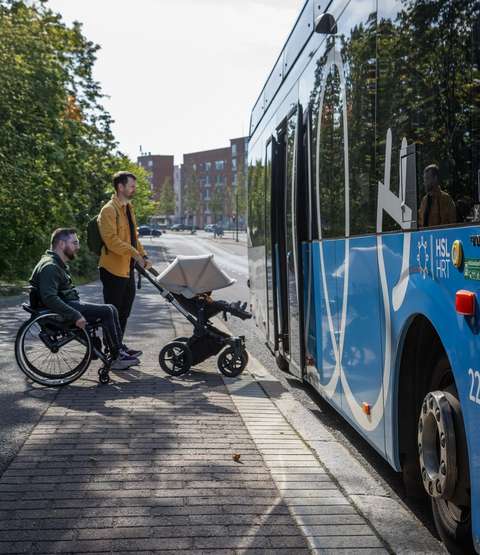
A large-scale survey on the accessibility of bus stops was carried out in Espoo in summer 2025. During one week, data was collected on a total of 1,417 bus stops. The survey provides an overall picture of the current condition of the stops and supports the development of accessibility
In previous surveys, information had only been collected on a small number of stops. This time, the survey was conducted with support from Traficom in cooperation with HSL, Riesa Consultative and Crowdsorsa.
Mobile game used as survey tool
The survey was carried out through crowdsourcing using Crowdsorsa’s mobile game. Participants added photos and measurement data for bus stops, which were evaluated by Riesa’s accessibility experts from the perspective of various accessibility criteria. The material includes geotagged photos and measurement data related to, for example, the slope of stops and kerb heights, as well as information on lighting, benches and warning areas. The effective data collection method provided a comprehensive dataset on the current accessibility of bus stops.
“Using the mobile game, we were able to quickly collect a large amount of data that has not previously been available for accessibility analysis. In the future, the development of accessibility can be data-driven, as the accessibility level of individual stops is known. This will also make it possible to examine more broadly the types of challenges that exist at the stops. Development work can also be monitored and the effectiveness of the measures evaluated,” says Accessibility Specialist Ella-Riikka Isometsä from Riesa Consultative Oy.
Data supports upgrading of bus stops
The collected data will be used to support the planning of bus stop upgrades.
“Bus stops are mainly upgraded as part of street renovation projects, but individual stops may also be upgraded in the coming years. The order in which stops are upgraded depends on factors like the number of users and nearby services, for example health centres. We are also reviewing additional improvement proposals for bus stops received from the Disability and Elderly Councils,” says Project Engineer Sami Oinonen from the City of Espoo.
Accessibility levels vary
The survey results show that accessibility at bus stops is inconsistent. About half of the stops have shelters, but only a small proportion of them meet all the examined accessibility criteria. Improvement needs were identified in boarding platform heights, warning areas, lighting, and older shelter designs.
The collected material was presented to the Disability and Elderly Councils, where discussions highlighted the importance of considering accessibility as part of the entire travel chain, as well as the importance of winter maintenance and the safety of stops. The councils also provided concrete proposals for future improvements.