Children’s culture and cultural education thriving in Espoo
Espoo has a stronger focus on children’s culture than many other cities do. Cultural education starts early at daycare centres with the Culture Call model and continues in schools through the KULPS Culture and Sports Path system. Children’s Cultural Centre Aurora offers different events, concerts and performances as well as art workshops and hobbies for families with children.
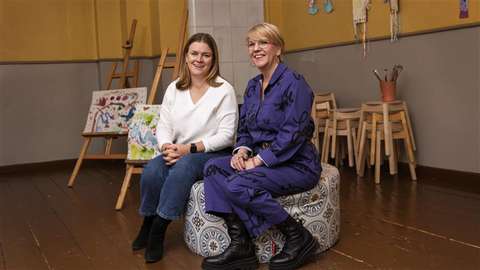
You could say that children’s culture is one of Espoo’s key factors of attraction - that is how strong its foothold is in the city. This is the perspective of Elina Harlas, Senior Specialist in cultural education and cultural content in upper secondary school studies, and Johanna Kallioaho, Production Manager at Children’s Cultural Centre Aurora.
A lot of interest in cultural education
In its current format, the operating model for cultural education in basic education has been used in Espoo since 2008, and other cities have also taken note. Especially Espoo’s procurement method for cultural services for children and young people has raised interest.
‘We offer consultations about the model we use in Espoo to other cities and talk about it at seminars and events, like at the Helsinki-Uusimaa Cultural Market,’ Harlas explains.
When asked why Espoo in particular has cultivated such a strong environment for children’s culture, Harlas and Kallioaho offer several explanations.
‘This city has an active cultural sector, which includes many operators in the field of children’s culture, and this has certainly had an impact. Of course, Espoo has also always had a reputation as a family-friendly city. Now it has been highlighted as a spearhead in Espoo’s strategy, which is really great,’ both say.
On children’s terms
Kallioaho and Harlas define children’s culture as professionally implemented activities that offer a basis for children and young people to experience culture and art and grow into it. Participation and experiencing are key factors in children’s culture. Children are included in creating culture rather than simply giving culture to them.
‘Our cultural education for children starts with involving children whenever it is possible. The activities come from the needs of children and young people, other aspects of art and culture only come into play after that,’ Harlas says.
‘Of course, it's not always possible to get the target group involved. Children’s Cultural Centre Aurora and Espoo’s other cultural centres offer numerous musical events and performances where the audience sits in their places as usually. However, the performances are meant to be immersive, and you can participate for example by dancing in front of your seat, which comes naturally to children,’ Kallioaho adds.
From day-care centres to schools
How does cultural education then show in the normal lives of children and young people in Espoo?
‘Implementing it out together with the city’s early childhood education and care services, our operating model that brings art education to children and related educational content to educators is present in all the city’s own day-care centres. There are about 140 of them in Espoo. In practice, this means that professionals from different fields of art visit every day-care centre in the autumn and spring semesters,’ Harlas explains.
‘This is how we can make the methods and practices of art a part of the everyday life of day-care centres and the visits won’t be just a one-off thing.’
For schools, the operating model has curated content appropriate for pupils in different grades and an offering of arts from which teachers can choose content that supports teaching. For example, cultural house content for the units is linked to the early childhood education and care plan of the City of Espoo.
‘We have collected a provider register together with the Procurement Centre that we can contact to request quotas for different content that we can offer to schools from different fields of art as diversely as possible. In addition, it is important that we take pupils of different ages into account. Third-graders and lower secondary school pupils might not be interested in the same content, so it is essential that the art offering is age-appropriate so that it is not boring,’ Harlas and Kallioaho point out.
Education in culture
Cultural education varies by age group: for children in day-care, the events and performances are brought to them, while it is more common for school-age children to go visit cultural sites.
‘Everyone knows that it is not easy to take 3- or 5-year-olds anywhere with public transport, so it is better to bring the performances to them,’ Harlas says.
However, if groups want to take a cultural field trip, Aurora and other cultural houses in different parts of Espoo offer many activities for children in day-care.
‘They also offer content for babies and toddlers at home that is suitable for their development period, such as colour baths for babies or toddler painting studios and gentle performances for only the youngest customers,’ Kallioaho says.
‘When you take older children to places like the theatre, museum, or cultural centres, it involves teaching about the consumption of culture. How they should behave during performances, what different cultural spaces are like, what is a cloakroom, and so forth,’ Harlas says.
‘When we were studying the impact of cultural education through teacher and pupil interviews, it was the teachers who pointed out that cultural education is also important from the perspective of equality, because not all children or young people go to museums or theatre in their free time for whatever reason. That’s why it is good if they can get this experience as part of the school day,’ she says.
‘And once a child has been to a museum, WeeGee or to the theatre, they can also act as our messenger and come back with their family since they already have experience with it,’ Kallioaho says.
Preparing for the future
Both Harlas and Kallioaho think that children’s culture in Espoo has a bright future ahead.
‘The new Mayor has already talked about the importance of an easy everyday life and good well-being of children and young people, and the new Espoo’s strategy is built around being the capital of children and youth, so I’m sure Espoo will continue to invest in cultural education and children’s culture. Especially when the city has such a strong image as a family-friendly place.’
‘When there are lots of providers and ideas, we can manage to do almost anything. The sky is the limit,’ says Kallioaho.
Naturally, cultural education as well as cultural and artistic experiences in the free time are also important as resources for children and young people. In addition to helping give faith in the future and foster creativity, Harlas and Kallioaho believe that these activities create capabilities for work.
‘Often people don’t understand that art and culture improve creativity and the ability to see things differently. It is a fact that successful companies invest in creativity, and a bit of “outside of the box” thinking can be the factor that sets you apart from everyone else,’ says Harlas.
‘Maybe cultural education can even offer young people in Espoo a future advantage, as practical and arts subjects will become a part of the matriculation examinations,’ she says.