Keran Hallit will be demolished taking circular economy into account – several parts will be reused
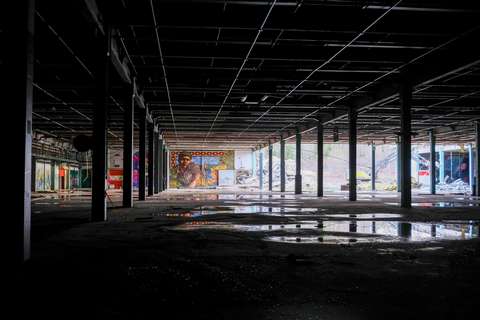
Keran Hallit, which served as a temporary service hub, will be dismantled now that the construction of Kera’s new residential area begins. The circular economy has been one of the central themes of the Halls since the beginning, and attention is also paid to it in the demolition process. In fact, several intact building elements have left the Halls for their second round.
Circular economy Kera
The new Kera residential area is one of the key projects for sustainable urban development in Espoo. One of the purposes of the temporary use of Keran Hallit was to already build practices of responsibility, innovation and resource efficiency in the area before the completion of the new homes. Sustainable development and the circular economy were visible in Keran Hallit in many ways.
“The circular economy was reflected in the operations of the Halls, for example, in the selection of companies based on the circular economy as tenants. The tenants were also encouraged to cooperate with each other and share resources. In addition, the Halls served as a development platform for several city projects: Kera has been the site for trials on urban food production, green walls utilising storm waters and various forms of urban culture. In 2023, the Kera Design Competition already sought concepts for the reuse of hall parts after the demolition,” lists Project Coordinator Outi Jounila from the City of Espoo.

Demolition generates a lot of emissions in cities, so demolishing the Halls was seen as an important way to still serve as a pioneer in responsibility in the final stages of operations. A goal in the demolition process was investing in reuse, that is, the use of goods, structures and building elements as such at another site.
“Reuse is always a more resource-efficient option than recycling – that is, reworking the material and using it for another purpose,” Jounila points out.
Hall pieces in new homes

Many Hall parts found a new owner even before the actual demolition began, as the tenants of the Halls took them with them to their new addresses.
“The walls of the rental facilities in the Halls were largely built by the tenants themselves, and many took the plywood and sheet metal structures with them when they left. In addition, many original parts of the Halls were sold to tenants: lifting doors, LED lamps, emergency exit lights, lockers, steel fences and stairs, and so on,” says Jukka Airo, the developer consultant of the demolition project from A-insinöörit.
So far, the largest individual reuse efforts have been transporting the Halls’ air handling units to Oulu and donating the backup power generators to Ukraine.
The air handling unit that served on the roof of the west hall will have a new life in Oulu, where a warehouse to be renovated for sports purposes needed more ventilation capacity. The reuse of the device was implemented by energy efficiency consulting firm nolla_E whose software makes it easier to assess the compatibility and profitability of reuse projects. A relatively recent device installed in 2009 still had plenty of useful life left. During the demolition process, the equipment was also thoroughly inspected and the necessary parts were replaced.

“Hesitancy about reused parts is entirely unnecessary. The life cycle of an air handling unit can be as long as 50 years, and when it is dismantled directly from use, there is no reason to doubt that it will also work correctly at the new address. In addition, checking the maintenance history of large devices and replacing parts is usually easy. As long as the planning is carried out carefully and the operation of the devices in the new property is confirmed, reused devices are often also much cheaper than new ones,” encourages Energy Specialist Tuomas Ojanperä from nolla_E.
The two backup power generators of the Halls were donated to Ukraine through Operaatio Ukraina and the Lion Defence Team. The generators had it easy at the Halls – they had only accumulated the hours of use required by obligatory tests. The generators from the demolition site are now in the war zone ensuring uninterrupted electricity distribution.
“One man’s trash is indeed another man’s treasure. The implementation of this was both professionally and personally touching and exciting,” explains Mari Pitkäaho, Real Estate Asset Manager representing the owner of the Halls, SOK.
As the demolition proceeds, the remaining parts suitable for reuse will appear on demolition contractor Purkupiha’s Purkutori virtual marketplace.

Reuse takes time, but rewards
The Hall demolition project is relatively favourable in terms of reuse, especially for one reason: the contract period is quite long. In any case, the large size of the Halls would require a longer contract period, but the landowner S-Ryhmä also wanted to enable a contract with an emphasis on the circular economy. The goals is to demolish Keran Hallit by summer.

“The short contract period makes reuse and recycling more difficult because the customer is rarely there waiting, and any intermediate storage increases both the carbon footprint and the costs,” explains Purkupiha CEO Jussi Thomander.
“From our perspective, the circular economy is above all sales work. We map out the parts to be resold, prove them to be usable and find a new home for them,” Thomander continues.
The process takes time, but often a demolition contractor versed in the circular economy also benefits the customer financially. According to Thomander, the lowest bidder usually also knows how to recycle best.
Once more, Keran Hallit demonstrates that more responsible operation is ultimately possible when it is selected together.
“People often imagine that this is more special than it is”, says Mari Pitkäaho.