Suitable truck charging locations mapped in capital region
Transport is the largest source of emissions in the capital region, and trucks are the second largest source of emissions in road transport after passenger cars. One reason for slow electrification is the lack of public charging infrastructure, which the EU-funded project ‘eCargo – Reducing truck emissions by developing EV charging network’ is aiming to increase. The first step was to test the existing public charging stations that have enough space to charge a truck. In addition, we examined where new charging stations are needed.
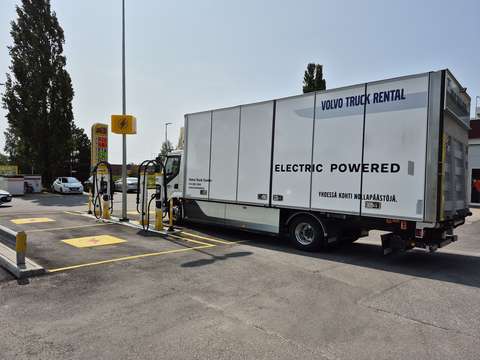

Public charging stations in the capital region are primarily designed for passenger cars. Only cars can fit in the parking spaces, and many charging stations are located in parking garages that cannot be accessed with a large van, let alone a truck.
Officially, there are no public charging stations for trucks. There are more than 50 electric trucks and 1,200 electric vans (situation as of 6/2025) registered in Helsinki, Espoo and Vantaa. Companies mostly have to charge these large vehicles on their own premises.
The lack of a public charging network for large vehicles considerably limits the usability and wider use of electric vehicles in freight transport. The same charging technologies can be used with all vehicles. The only difference is that trucks and vans need more space.
Charging trucks and vans at public charging stations for cars
Carried out by the City of Espoo, Forum Virium Helsinki and Metropolia University of Applied Sciences, the EU-funded eCargo project tested the suitability of the existing public charging stations for large vehicles. The tests were carried out in the capital region during the spring, summer and autumn of 2025 using five different electric trucks and vans: Mercedes-Benz eSprinter, Renault Master E-Tech electric, Mitsubishi Fuso eCanter, Volvo FL Electric and Mercedes-Benz eActros 300.
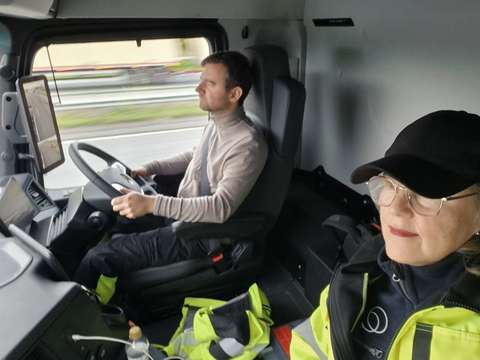
The testers found 25 charging stations with enough space for trucks that are up to ten metres long and four metres tall. These stations were also reported on the widely used Latauskartta.fi website. Vans that are about seven metres long and three metres tall could also fit into ten other charging stations, i.e. 35 stations in total. In other words, charging is possible, so that alone should not be a reason not to purchase electric freight transport vehicles.
“However, almost all charging stations do have some limitations, as they are designed for passenger cars,” says Raimo Tengvall, Senior Specialist of Electric Mobility at Forum Virium Helsinki. For example, Tengvall points out that the locations are often not optimal for freight transport, a large vehicle may block visibility of traffic, and charging cables are often too short for trucks. “You have to drive to most charging stations with the front first, which means that you then have to back the large vehicle out of the space, which is not good for traffic safety.”
There is a clear need for public charging stations for trucks and large vans in the capital region.
Needs for new charging stations mapped
The eCargo project tested a new way of identifying charging needs by combining a survey conducted among transport companies with vehicle data on about a thousand truck journeys in the capital region. Anonymous vehicle data was obtained from Bridgestone Mobility. A total of 12 medium-sized and large transport companies and purchasers of transport services responded to the survey.
The aim was to find out where diesel-powered trucks and large vans are parked overnight and where they stop for more than half an hour during the day. Transport companies cannot afford any additional stops, so the current parking areas are the only sensible locations for charging vehicles when they are later replaced by electric ones.
Based on the experimental work, a preliminary heatmap was created to visualise truck and van charging needs. The map highlights logistics areas in Vantaa and in the ports in Helsinki as well as many other areas around the capital region. In addition to small industrial areas and commercial areas, trucks and vans are typically parked overnight on the side of streets near drivers’ homes.
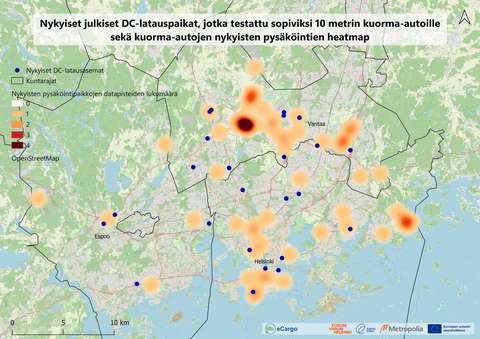
“Adding charging stations for heavy vehicles in key logistics, industrial and commercial areas would rapidly promote the green transition in the transport sector,” Tengvall says.
The heatmap shows that trucks and vans have varying driving profiles, which cities should study more systematically in the future.
“However, you should not wait for new charging stations. In addition to charging your vehicles on your own premises, the current public charging stations are, according to the eCargo mapping results, quite useful to those driving electric trucks and vans in the capital region.”
Read more about the eCargo project: eCargo – Reducing truck emissions by developing EV charging network