A piece of urban space for pleasant bike parking
Espoo is experimenting with a bicycle parking pilot to increase local urban attractiveness, bike racks and seating space. The pilot will consist of Parkly’s modular parklet urban furniture, which are made of parts that can be adapted to various needs following the principles of the circular economy. The pilot is part of the City of Espoo’s Sustainable Future Districts pilot programme.
The City of Espoo and Parkly Oy are piloting a solution aimed at improving the attractiveness of urban spaces and bicycle parking while improving the comfort and conditions for carbon-free modes of transport, i.e. cycling and walking. The urban furniture will be made up of parklets, i.e. bike racks, seating, and green modules.
A parklet consists of roughly ten pieces of modular urban furniture. They include 8–10 safe places to lock a bike frame, which are an integral part of the modules. The green modules will receive with plant species that support the local nature. InnoGreen is responsible for the green services.
The street area on Leppävaarankatu 9, close to Sello and the library, was chosen as the pilot location. Current plans include a suitable module configuration and a small event on Espoo Day 29 of August 2025(external link, opens in a new window). The city will seek experiences and opinions from city residents throughout the pilot to develop the bike-parking module.
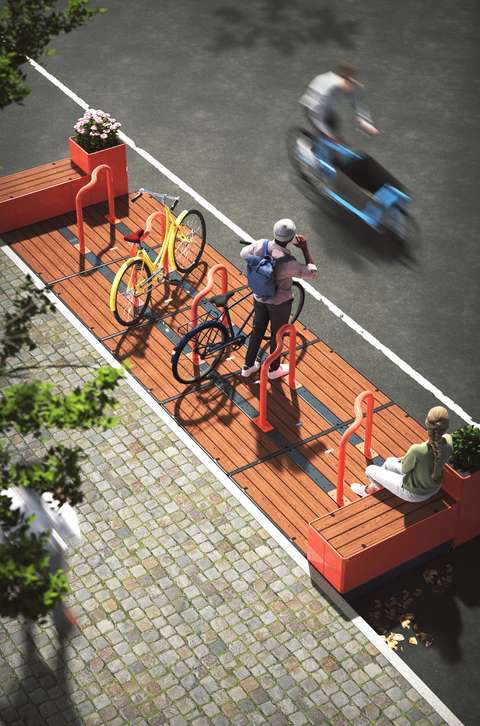
“Streets are an important part of any city, which is why we have wanted to develop new and versatile solutions for using the street space – promoting both sustainable mobility and pleasant places to stop. By combining several functions, such as bicycle parking, green spaces and seating, we can reach different users: for someone, a bench on the street can be an incentive to start walking, while for someone else, it is a convenient rack to lock their bike for the day. Our modular parklets are also stops for pollinators,” says Päivi Raivio from Parkly.
The module is open to everyone and is designed to be accessible in both meanings of the word. They are movable, do not require a fixed installation, and can be modified and expanded as necessary. The design and selection of materials have taken life cycle and versatility into account to follow the principles of circular economy design, and emissions from transporting the modules are kept to a minimum. Parkly manufactures its furniture in Finland.
Towards more attractive and sustainable streets
The main themes of the pilot are developing a pleasant and safe traffic environment, boosting modes of sustainable commuting and improving their attractiveness, and improving temporary pedestrian and cyclist arrangements in a changing urban space. These themes are strongly linked to the City of Espoo’s ambitious emission reduction targets: It is Espoo’s goal to become carbon-neutral by 2030.
The pilot also creates discussion on the distribution of the street space and developing it to be attractive to everyone. Sustainable transport is worth promoting for the sake of both the climate and human well-being. Parklets and other modular solutions can contribute to attractive and sustainable cities of the future.
Give feedback on the pilot here(external link, opens in a new window).
More information on the event can be found here: Opening of Parkly's MOVE parklet(external link, opens in a new window)