Responsible and sustainable event
The Espoo community, the city's ethical principles and sustainability are at the heart of the City of Espoo's event work.
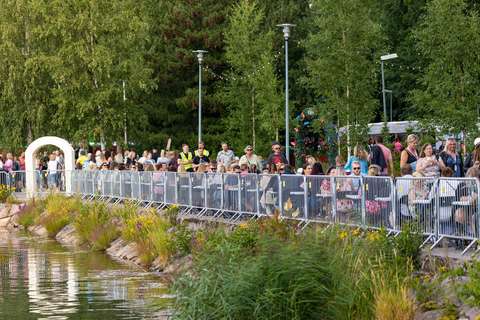
Espoo monitors the environmental impacts and responsibility of public events. The event organizer is responsible for ensuring that the event is safe, healthy, functional and environmentally friendly. Events organized in Espoo must be implemented from a sustainable development and responsibility perspective in accordance with the Sustainable Espoo Program and the UN Sustainable Development Goals (SDGs). A responsible event also takes into account social and economic responsibility principles.
Event accessibility is made up of many different factors. An event producer should take the requirements for an accessible event into account as early as the planning stage. Activities can be placed in locations that are as accessible as possible, communication can be made diverse, and barriers to understanding can be removed through options such as different language versions and customer service.
More information: Culture for All service(external link, opens in a new window)
Responsibility and environmental sustainability must be taken into account in the production of events organized in Espoo. Events have many significant environmental impacts, but they can be reduced with the right actions and good advance planning. The event organizer must take care of the environmental issues of the event in accordance with the regulations.
In Espoo, the environmental requirements for waste management and hygienic arrangements apply to large outdoor events that are expected to be attended by more than 500 people at the same time and where unpackaged food is offered or sold. The event may cause noise pollution to the environment, and in order to reduce environmental pollution, large public and outdoor events may require a noise notification.
Noise
When planning an event, take into account that normal life will continue in the surrounding area – despite the event. Noise can be a major nuisance to the environment and even a health risk to event guests. Find out about the event’s noise notification obligation well in advance at ymparisto@espoo.fi. Temporary noise may occur during the event, but also during the construction and demolition phases. If sound equipment is used at an outdoor event and this causes particularly disturbing noise, the event organizer must file a noise notification with the City of Espoo Environmental Protection Services no later than 30 days before the event.
A public and outdoor event may require a noise notification if the event causes particularly disturbing noise after 8 p.m. In Espoo, music at events that have received a noise notification decision generally ends at midnight. This is how you reduce the noise nuisance at the event:
- Adjust the music volume to a level that is suitable and pleasant for the listeners, and position the stage and sound system away from the apartments.
- Take into account the transmission of noise over water and the reflection of noise from hard surfaces. Bass directed towards the sea or lake can be carried for kilometers, and even further in calm weather.
- Inform the residents of the surrounding area in writing in advance.
- Particular attention should be paid to noise-sensitive areas, such as residential apartments, schools, daycare centers, hospitals and cemeteries.
Waste management
The event organizer is responsible for organizing the waste management of the event. The organizer is also responsible for providing advice on waste management during the event, as well as for sorting, separate collection of waste and emptying containers in accordance with waste management regulations. The event organizer or convener must clean the event area and the surrounding area immediately after the event. However, there is no single right way to organize waste management at an event - suitable solutions always depend on the nature and location of the event. Waste management for public events When planning a public event, it is important to strive to minimize the amount of waste generated. If more than 500 people are expected to participate in the public event at the same time, the event organizer must submit a waste management plan to the Environmental Protection Services of the City of Espoo 30 days before the event.
Hygienic arrangements
A large public event, where more than 500 people are expected to attend at the same time, must reserve a sufficient number of toilets with handwashing facilities for the public. One toilet must be reserved for people with disabilities for every 1,000 people. The event organizer must be prepared to acquire additional toilets on site quickly enough, if necessary. The toilets must be located appropriately in different parts of the event area. Signs must be placed in the area indicating the location of the toilets. The toilets and waste containers must be emptied hygienically and sufficiently frequently. The waste management plan must include information on the location and number of toilets to be moved, as well as the contact information of the party responsible for the waste management of toilet waste.
More information: Finnish Supervisory Agency(external link, opens in a new window)
Smoking prohibitions
The smoking prohibitions and restrictions of the Tobacco Act are intended to protect the population from the health hazards of second-hand smoke. According to Section 74.1(2) of the Tobacco Act, smoking is prohibited in canopies and stands of public events held in outdoor areas, as well as in other areas intended for direct observation of the event, where participants remain seated. According to Section 73 of the Tobacco Act, the prohibition also applies to, for example, the use of electronic cigarettes and the smoking of hookah tobacco and herbal products intended for smoking in a hookah. The smoking ban applies to both paid and free public events, and is in force throughout the public event. In accordance with Section 80 of the Tobacco Act, the owner of the outdoor area and the organizer of the public event must mark the no-smoking area with clear, sufficiently large signs so that it is clearly visible to those entering and staying in the area. It is also a good idea to mark any area intended for smoking. If the grandstand or canopy intended for watching the event is built permanently, it is justified to permanently attach signs indicating the smoking ban and any space designated for smoking to the premises. On a grass field intended for watching the event or in another open space, the event organizer can indicate, for example, with signs and maps, the area immediately intended for watching the event, outside of which smoking is permitted. Smoking at public events organized in outdoor areas may be permitted outside the area immediately intended for watching the event. On an open grass field, the area that is not intended for watching the event directly and where smoking is therefore permitted may be, for example, 50–100 meters from the stage. The event organizer should assess the extent of the smoking ban area above rather than below, so that cigarette smoke does not spread from the smoking area to the audience watching the event.
More information: Smoking prohibitions, Finnish Supervisory Agency(external link, opens in a new window)