Buildings in Espoo protected by the law
Buildings that are culturally and historically valuable can be protected either on the basis of town planning or conservation of buildings. In order for a building to be of historical value, it must have characteristics referred to in the legislation (498/2010) concerning building heritage. These include rarity, historical typicality and significance as evidence of historical events. In Espoo, the following buildings are protected under the legislation concerning the conservation of buildings.

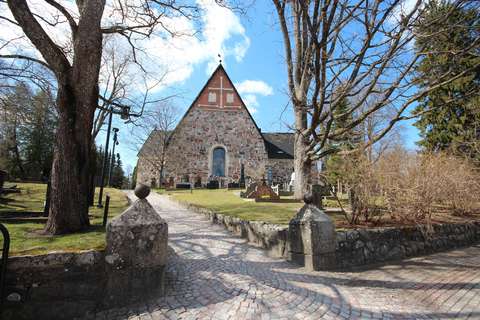
The Espoo parish split from the Kirkkonummi parent parish and became an independent parish in 1458. Before that, it had served as a dependent parish with a wooden church built in the middle of the 14th century. Timber from the wooden church has likely been used in the construction of the new church. The stone church was completed in the late 15th century. At the time, there were a total of 1,900 subjects of the Swedish crown living in the villages of Espoo.
The preserved features of the medieval stone church include rich interior paintings and the western and eastern parts of the nave. The paintings are likely the work of Swedish or foreign church decorators. The original church building included, in addition to the nave, a smaller sacristy and an armoury. The armoury was demolished in 1804–1806.
The church was converted into a cruciform church in 1821–1823. This included demolishing the original southern and northern walls and the three central vaults.
The medieval paintings were whitewashed to improve lighting in 1791. They were restored when the church was renovated in 1931. The renovation was planned by architect and professor Armas Lindgren. The next significant renovation came in the 1980s when the altar was moved from the end of the chancel to be closer to the parishioners and the wooden sculpture Kärsivä Kristus depicting a suffering Christ was returned to the most central place in the church.
The construction of the Pasila–Karjaa section of the railway between Helsinki and Turku was decided by the Assembly of Estates of Finland in 1897 and the construction began in 1900. The Kauklahti station was completed in 1903. It was designed by architect Bruno Granholm, just like the other stations following the original plan for the coastal railway.
The station area included both the station building and residential buildings. However, many of them have been demolished over the years. Only the stations of Espoo, Kauniainen, Tuomarila and Kauklahti remain. And even they do not serve any passengers. The Kauklahti station acted as a border station between Finland and the Soviet Union for the period 1944–1956 when the Porkkala area was leased to the Soviet Union. On the west side of Porkkala, the corresponding station was Tähtelä. As of 1947, the Soviet Union allowed five pairs of trains to run through the area every day. In Kauklahti and Tähtelä, the shutters of the carriages were closed and the locomotive of the train was replaced with a Soviet one. There were also Soviet guards posted at the vestibules. Because of the shutters, the railway running through Porkkala was called “the world’s longest railway tunnel”.

The main building was designed by architect Wivi Lönn and it was completed in 1917. At the time, Wivi Lönn was already known for her designs of significant public buildings, but she also designed things such as private villas. The two-storey, timber-framed and boarded main building is a prime example of the villa architecture with classical influences that was popular in the 1910s.
Villa Koli was built as a summer villa by professor Juho Jaakko Karvonen and his wife Anna Robina (née Tiililä). Karvonen served as the Director General of the National Board of Health in 1917–1920. According to oral tradition, at least the timber of the main building is from Northern Finland.
The daughter of archiater Karvonen remembers well the negotiations with architect Lönn on the details of the construction of the villa. The incidents include Lönn losing the construction drawings of the villa when she was taking them from Helsinki to the construction site in Koukkuniemi. However, the drawings could be recovered through a newspaper advertisement.
In 1928, the villa was sold to Director E. E. Granberg, who in turn sold it to Director Yngvar Lundberg in 1938. The Lundberg family owned the villa for more than forty years. The villa was used only during the summer. Since 1982, the villa has been owned by a construction company.
Originally, the plot of the villa extended all the way to the beach, but when the town plans were prepared, the beach was separated into a park area. The current owner of the villa has rented the park area.

Alfred Kihlman (1825–1904), a prominent figure in the worlds of business and education, bought the uninhabited wooded Rullund peninsula belonging to the Kaitans croft in 1873. By June of the same year, the first villa building was completed on the peninsula. In 1892 or 1894, Alfred Kihlman's son, lawyer Mauriz Lorenzo Kihlman, built his own summer villa in the same yard, next to the Vintervilla which was fit for winter habitation. In its original form, the building was very modest and with its ridged roof, six-pane windows and open porches it resembled an ordinary croft.
Lorenzo Kihlman's villa, "Päijännestugan” or "Sommarvillan", was connected to the older villa with a corridor. On the sea side of the building, there were originally two symmetrical open verandas on both sides of a large landscape window. Later on, one of the veranda windows was replaced by a wall. A two-storey tower designed by architect David Frölander-Ulf was built at the end of Päijänneestugan in 1901. The Jugendstil tower was built by an Ostrobothnian carpenter only known by his surname Harju. Around 1908, the old Vintervillan was raised according to the plans of architect Hjalmar Åberg.
Villa Rullud was the summer residence of the Kihlman family until 1980, and a total of five generations of Kihlmans spent their summers on the peninsula. One of the last users of the villa was author and honorary arts professor Christer Kihlman. Villa Rullud is one of the first villas built as summer residences in Espoo, along with Tallholmen, Granholma and Kuusisaari's Villa Krogius and Villa Lindelöf.

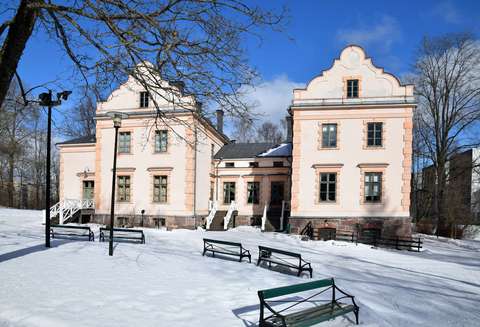
The owner of the Töölö sugar mill, consul Feodor Kiseleff, bought the Alberga estate in 1855. He built a new main building for the manor in 1874. The building is called Sokerilinna (“Sugar Castle”). Boards more than half metre wide that were collected from the raw sugar boxes sent from abord were used as construction material. The manor's blueprints are signed F.L. C-s, which means that the building was designed by architect Frans Ludvig Calonius.
The manor house is an example of the Nordic baroque style and its layout is shaped like a horseshoe that opens to the south. Both wings have two storeys, the middle part only has one storey. Below the building lies a vaulted cellar.
In 1900–1917 when the manor was owned by the Slöör family, several grand celebrations were held at the manor where the guests reportedly included even Marshal Mannerheim. Artist Akseli Gallen-Kallela also lived for short periods of time in the new Alberga, as it was owned by his wife’s parents. In the 1930s, Inkeri Lakari managed the Restaurant and Boarding House of Alberga Manor, and the management transferred to Elma Virtanen in 1937. Land development company M.G. Stenius Ab owned the manor from 1917 until selling it to the City of Helsinki in 1938. The ownership of the manor was transferred to the City of Espoo in 1983.
The history of Alberga Manor dates back to 1622, when King Gustav II Adolf gave the lands of the village of Suurhuopalahti to Major Johan Gyldenär. The old Alberga park was founded in the mid-18th century by Carl Tersmeden, who bought Alberga Manor. The park has been restored to its original baroque style on the basis of archaeological excavations and research.
Artist Akseli Gallen-Kallela designed his studio and his family's home on the peninsula called Linudd. Completed in 1913, the building represents National Romanticism and Jugendstil architecture. The studio, named Tarvaspää, was built on the steepest slope on the cliffs. The stone building can be described as an amalgamation of a medieval church, the octagonal tower of the Vyborg Castle and a Florentine loggia.
At the time of its completion, the studio building was modern; it had central heating and water supply. But other things, such as a kitchen, were missing. The building was originally planned as a museum building. It stood uninhabited in 1915–29. The reasons for this included the fortification work by the Russians and the construction of a road for transporting guns at the bottom of the villa plot. Reluctantly, Gallen-Kallela once again adjusted his villa that evoked in him emotions that he did not like. The annexe of the studio and the alteration work on the house were completed in 1930, a year before the artist’s death. Gallen-Kallela himself took an active part in the construction work by, for example, building walls. As a museum, Tarvaspää was opened to the public in 1961. It was preceded by restoration designed by architects Kirsi and Heikki Helamaa.
The construction of Gallen-Kallela’s atelier castle was part of the era’s phenomenon in which Finnish artists built their studio homes far from the city. Examples of this are Akseli Gallen-Kallela and Ellen Thesleff in Ruovesi in the late 19th century as well as Jean Sibelius, Pekka Halonen and Juhani Aho by the shores of lake Tuusulanjärvi. Tarvaspää is part of the regionally valuable man-made landscape of Laajalahti: Munkkiniemi–Tarvaspää–Ruukinranta (Villa Elfvik).

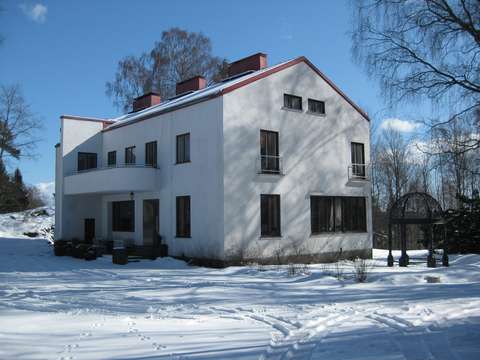
Located west of Bemböle, near the historical mill site, Villa Solkulla was built on a hill that once faced an uninterrupted field-filled landscape that reached the Espoonjokilaakso river valley. The first Villa Solkulla was a modest one-storey cottage completed in 1900.
Engineer Knut Törnroos, the managing director of Putkiliike Huber Oy, bought the plot and its buildings in 1921 for his agricultural hobby. The cottage was demolished in 1925 at the latest and it was replaced by a two-storey villa decorated with classical motifs. The land of the self-sufficient villa covered a total of 100 hectares of garden and cultivated land. However, the villa was demolished in 1936, and architect Uno Ullberg designed the current Villa Solkulla. The building is a large, functionalism-styled villa with two storeys and a saddle roof. It was completed in 1937.
Paul Olsson's garden design from 1931 with its front and back gardens adds to the cultural-historical value of the villa. The remains of the garden can still be seen, and north of the villa, a pavilion of iron and glass has survived.