At a vantage point at the centre of the Espoo Story – Ulla Lehtonen and Jussi Paavola put the strategy into practice
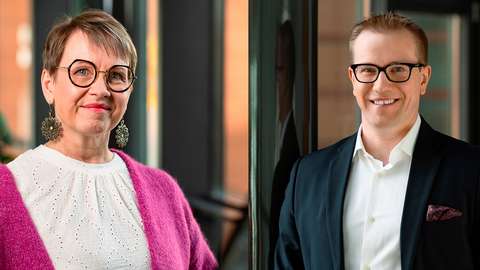
Ulla Lehtonen, Director of Finnish Early Childhood Education, and Jussi Paavola, Director of Finnish Upper Secondary Education, are motivated by Espoo’s positive attitude towards education and the City's bold and determined approach.
What does your new job involve?
Ulla Lehtonen: As Director of Finnish Early Childhood Education, I am responsible for municipal and private early childhood education and care and pre-primary education. I am responsible for ensuring that the Espoo Story is implemented in early childhood education and care, that there are enough places in early childhood education and care for the growing city, there is enough staff and their wellbeing is ensured, and high-quality early childhood education and care is realised for every child.
Jussi Paavola: My title is Director of Finnish Upper Secondary Education, but as I am a director in general administration, I am a kind of jack of all trades. In this work, the emphasis is on strategic management and cooperation in various networks, between the municipalities of the Helsinki Metropolitan Area and nationwide.
Where did you work before this position?
Ulla Lehtonen: My latest workplace was in Järvenpää, where I was the director of early childhood education for just under three years. I was responsible for municipal and private early childhood education and care as a whole. Before that, I worked at the City of Helsinki, for the longest time as a manager of early childhood education and most recently as the director of early childhood education. I have worked my entire career in early childhood education and care: I started as a teacher of early childhood education and care in the 1990s.
Jussi Paavola: My career began in 2003 in Uusikaupunki, where I worked as a lecturer of social studies in a lower secondary school and later also as a deputy principal, principal and vice principal. During the coronavirus pandemic, I moved on to Rauman Lyseo upper secondary school and then became the service area director of general upper secondary education and general adult education at the City of Turku.
What attracted you to your new job?
Ulla Lehtonen: I am particularly impressed by the bold, determined, clear and narrative strategy. What was also interesting about Espoo was that, unlike in many other municipalities, the number of children and families here is constantly increasing. It's a big motivator for my work. I was also interested in the way Espoo invests in the quality of early childhood education and care and the development of leadership.
Jussi Paavola: This is a vantage point in many ways, and the city’s positive attitude to education also attracted me. Espoo and its residents have been a very positive surprise to me. The people who work here and live here are really very nice.
Children and young people are at the centre of the Espoo Story. What do you do in your own work to achieve this goal of the Espoo Story?
Ulla Lehtonen: The Espoo Story is the core of all my work, as my work is about living and managing the strategy. The strategy goes hand in hand with me in the work of the management team and in the preparation of decision-making, the allocation of resources and the prioritisation of my own schedule.
Jussi Paavola: The general upper secondary schools in Espoo are already doing really good work on the elements of this story. The idea that everyone can achieve their own potential is great. Finnish upper secondary education is excellent in other ways too, as it does not have any dead ends. It is important that every young person finds their own place and is inspired and motivated by what they want to do when they grow up. In my work, it is essential that I can, together with the principals, enable these goals to be achieved so that young people can achieve their best potential.
How smooth has cooperation between the different actors at the City of Espoo been?
Ulla Lehtonen: I have had a very good and warm reception, and it has been great that I have been actively contacted from different parts of the City. I have been able to create contacts and networks with a large number of different actors from the start. I have also met a lot of different actors from outside the City, such as private early childhood education and care service providers, representatives of organisations, and companies.
Jussi Paavola: Starting form recruitment and orientation, everything has gone extremely well. I have been able to meet a wide range of people working for different actors at the City. This is probably the reason why interaction across different administrative boundaries and profit units has developed so well. I have felt welcome from the very beginning.
What should your new colleagues know about you?
Ulla Lehtonen: I am inspired by interaction and doing things together, which is why I have intentionally been present a lot here in Karaportti. I easily give positive feedback and laugh a lot. Humour is part of every working day, and I easily create a good and relaxed atmosphere around me. Even though things are sometimes difficult, they can also occasionally be handled lightly and through humour. I am not and I will never be a morning person.
Jussi Paavola: I am an open and true Ostrobothnian, and proud of my roots. I live alternately in Uusikaupunki and in Kauklahti, and my hobbies include CrossFit and other physical activity, studying alongside work and playing the clarinet.
Your best tip for recovering from work?
Ulla Lehtonen: I think everything starts with a balanced life. For that, you need work, family, free time and friends. In my free time, I go jogging with my dog, enjoy culture and meet my friends. I do a lot of physical activity, right now I’m into spinning.
Jussi Paavola: Physical activity and taking care of yourself by having a healthy lifestyle in general help both your mind and your body keep in shape. Healthy selfishness is sometimes good, as in principle, it would be easy to do too much of this work. Sometimes recovery from work requires brisk physical activity, sometimes a walk in the forest, and some other time a concert, for example.
Text Pi Mäkilä, photos Amanda Lehtola.