School attendance is supported systematically
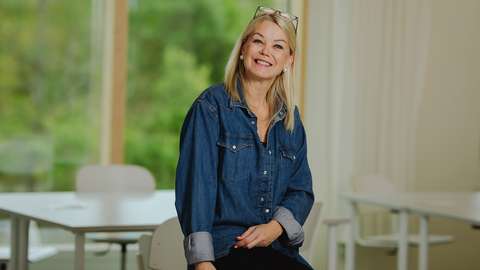
Author Tarja Västilä.
Absenteeism among comprehensive education pupils increased following the COVID-19 pandemic, but Espoo did not sit back and do nothing: school attendance is supported systematically and without attributing blame.
HYMY pupils have pinned to the noticeboard pupils' responses to the question of what they like best in Tiistilä School. There is a throng in front of the board: this information is interesting. Lovely teachers, new school building, great friends, food, indoor breaks...
"We can also support pupils' well-being and a positive atmosphere at a minimum level. The around twenty HYMY students of the upper comprehensive school organise feel-good events and various challenges. The HYMY resource is like a low-threshold entrance hall in Tiistilä School," explains Mervi Salminen, the developer teacher of school attachment, homeroom teaching and health education.
While the developer teachers in Espoo have varying job descriptions, Mervi’s work focuses on school attendance.
A longing for encounters
The Finnish National Agency for Education, the Ministry of Education and Culture and municipalities created together a national model for supporting school attendance and intervening in absences. The model was introduced around three years ago and has been followed systematically in Espoo.
"Absences increased following the COVID-19 pandemic, and now we are making active efforts to turn this trend. School satisfaction is affected by a number of stress factors, including learning challenges, friendships, teenage years and feeling that you don’t belong," says Mervi.
The city’s statistics indicate that the number of pupils who are absent a lot has started to decline. While these pupils accounted for 15.6% in spring term 2025, the corresponding figure this spring was 13.7%.
Young people’s daily lives have changed, and there are other things demanding their attention besides school. The mobile phone is a major reason; young people go to bed too late and struggle to wake up in the morning.
"We live in an era of individualism, which does not make room for spending quality time together. A child or young person may also feel that they do not get experiences of success or have interpersonal relationships at school. Absenteeism is always a symptom of something. This is why you must pause at a pupil and really see them. Encountering others is a core need in humans."
Intervention in absences through Wilma
Children often spend more time at school than anywhere else, such as at home, in hobbies or with friends. While parents’ responsibility cannot be overlooked, the school also does everything it can for the pupil.
"Rather than just focusing on the problem, we should look for solutions. The model obliges schools to engage in preventive work: the pupil’s attendance must be supported by all means provided by the school culture, and intervention in absenteeism must be systematic," Mervi stresses.
In spring 2026, Espoo introduced Wilma's Noti function, which automatically monitors pupils’ absences. If a pupil's absences amount to more than ten per cent of the lessons over a three-month period, the teacher, the guardian and the pupil will receive an electronic reminder of this through Wilma.
"The pupil may have been sick for a week, which may already have left gaps in their learning. This is about caring: we make sure that everything is fine. Monitoring helps us create a safety net." The guardians also become aware of the situation, and the child feels that the school cares about them.
Apart from permissible absences a child or young person may, for example, say that they have a stomach pain if they do not feel like going to school. This may mean that the child is upset about something that happened with their friends.
"In such cases, special attention should be paid to reattachment to school after the absence."
Every young person is unique
It is often enough for the home to be aware of the child's absenteeism and its reasons and get involved in supporting their child’s school attendance.
"When I meet a young person who doesn’t seem to enjoy school, I start by talking about other topics completely, such as hobbies. Pupils are eager to make contact and wish to be noticed. A positive connection is the starting point for the discussion. A young people should be seen as a unique individual, not as a problem.
If the absences keep increasing, the school will consult the communal student welfare services. If a multiprofessional meeting is needed, it can be attended by the school social worker, psychologist, nurse, special needs teacher, study and careers adviser, subject teacher and homeroom teacher. In some cases, social welfare services outside the school may also be needed as an enhanced support measure.
Coming to school should feel good
Mervi says it is important for the pupil to feel that there are safe adults at school. Studies indicate that a warm relationship between the teacher and the pupil is the most important single factor in school attachment, but any safe adult is enough. Sometimes this might even be a school cleaner who notices the pupil and gives him or her a moment of their time.
“The key is that the child or young person comes to school. They must not stay at home without a good reason. Coming to school should feel good, it should be a place with a positive school culture and a safe atmosphere. Learning and well-being support each other.
The developer teachers provide sparring, inspiration and support for developing the school culture in keeping with the objectives of the curriculum, whereas Mervi's role is to give talks about school attachment and preventing absenteeism at schools, guardians' evenings and similar.
