Iida, a student at Tapiolan lukio general upper secondary school: “Make the most of upper secondary school, both academically and socially!”
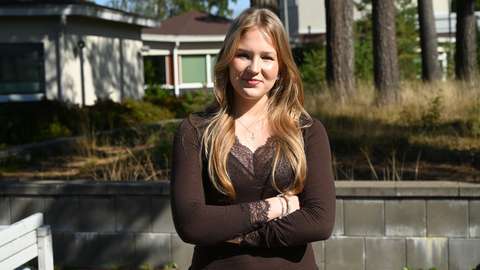
Iida Karjalainen, a second-year student at Tapiolan lukio general upper secondary school, became interested in making a difference when she was still at primary school. She is a member of the student body board and is serving her second term on the Youth Council. Iida enjoys the freedom of choice that upper secondary school offers. She reminds prospective students that while there is more work than in comprehensive education, you can choose your own areas of interest.
Iida Karjalainen is a second-year student on the general programme at Tapiolan lukio general upper secondary school. She attended Tapiola School on the music programme for comprehensive education, but wanted to focus more on her academic studies, particularly history and social studies: “My comprehensive education history teacher praised Tapiolan lukio general upper secondary school’s history and social studies teacher, Pia Liimatainen, as a great teacher.” It’s no surprise, then, that Liimatainen’s classes have become her favourites.
”The building is the same as in comprehensive education, and I eat the same food in the same canteen, but it really has been a step up from before,” Iida reflects. She likes the fact that Tapiolan lukio general upper secondary school is relatively small, with a great community spirit. “My friends are lovely. And there’s so much on offer here: humanities, study trips and languages,” Iida enthuses.
Even though Iida moved from comprehensive education to upper secondary in the same building, she didn’t have many friends at first. “But now I have great friends pretty much everywhere,” Iida says.
Making a difference ever since primary school
Iida has always known that she wants to make a difference. She sits on her school's board of the student body and is the vice-chair of the Youth Council. She is now serving her second term on the Youth Council.
From an early age, she has been interested in having an impact. She was on the student body as early as primary school. “Fairness is really important to me. It’s important to notice things that aren’t right and do something about them,” Iida says. She points out that the student body board is a great place to practise expressing yourself and develop communication skills. Iida is so enthusiastic about having an impact that she says she even works on student body matters in her free time. At the moment, Iida is looking forward to a wellbeing event taking place later this autumn. Every upper secondary school in Espoo received €2,000 to promote wellbeing, and Tapiola Upper Secondary School will be using the funds for this event.
But can you really make a difference through student body activities? “On the whole, I definitely feel I’ve been able to have an impact,” Iida states. You can make an impact even with the little things. With phones banned in comprehensive education, Iida mentions that one of the things she pushed for was having printed lunch menus put up where everyone could see them.
Iida points out that every upper secondary school in Espoo genuinely wants to listen to its students. She has had the chance to get to know the teachers and the principal better. On the Youth Council, she has, for example, connected with Espoo city officials and learned formal administrative language as well as debating skills. She has also been able to connect directly with other changemakers.
Freedom of choice in upper secondary school
In upper secondary school, Iida enjoys the freedom to focus on what she is truly interested in. She can build a timetable that suits her. She doesn’t even mind turning up to school at eight on a Monday when she has social studies. During this period, Iida only has classes in the morning on Mondays.
When asked about her best memory of upper secondary school so far, Iida has to pause and think for a moment. There are so many good memories. A tug-of-war tournament in the school corridor is one memory that clearly stands out. In the end, though, Iida picks the May Day event she hosted as her favourite memory. “We had a traditional hands-free doughnut-eating contest, a magician, and a ‘Song of My Life’ game based on the teachers’ favourite songs. We also had a best dress contest.”
“You’re in charge of your own studies”
At the beginning of year two, plans for what comes after upper secondary school are naturally still wide open. Iida has been considering whether to continue her studies in Finland or abroad. She puts effort into all her subjects at upper secondary school, as she doesn’t yet know what she might specifically need in the future. If she stays in Finland for higher education, she plans to apply to law school.
To current ninth-graders, Iida points out that while upper secondary school involves more work than comprehensive education, it is up to the students themselves to decide how tough it gets. “If you decide not to put the work in, keeping up is going to feel hard. You are in charge of your own studies. You can choose what interests you.” Iida also advises future upper secondary students to learn their limits and to go easy on themselves: “Don’t be too hard on yourself. Keep in mind that you only go through upper secondary school once in your life. Make the most of upper secondary school, both academically and socially,” Iida says.
Friendships are important for young people. Iida points out that friendships can be maintained even if you end up at different upper secondary schools. “It’s also not the end of the world if you don’t get into your first-choice school in the joint application procedure,” she says. She encourages students to visit as many schools as possible before making their choice.