Espoon keskus will become a vibrant and appealing urban centre
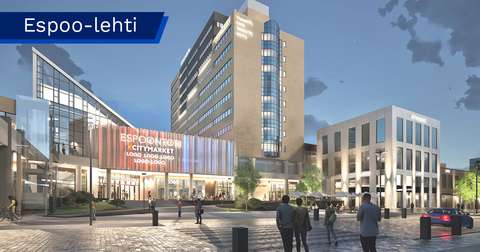
In a few years’ time, Espoon keskus will look very different from today. In addition to the renewed street environment, hypermarkets and residential housing, the plans include a wider range of services and more people.
Espoon keskus is undergoing one of its most significant transformations in decades. Within just a few years, the area will become more appealing thanks to pedestrian-friendly street plans, brick-and-mortar shops, large supermarkets, harmonious building façades, and a bus terminal featuring a green roof.
“The aim of this major redevelopment project is to raise Espoon keskus to the level of other urban centres,” says Project Manager Mikko Kivinen.
Approximately 30,000 people live in the Espoon keskus area, but it provides services to a much wider population, including the residents of Kirkkonummi. The more attractive the area becomes, the more likely people are to visit Espoon keskus instead of the other urban centres, such as Leppävaara or Matinkylä.
Large supermarkets attract customers
A Citymarket is currently under construction at Espoontori, and a Prisma is being built on the site of the former S-market next to Entresse. The construction sites are changing routes and causing temporary arrangements, but the wait will be rewarded within the next few years.
“A lot is going on right now. Construction is visible in daily life through worksites and temporary arrangements, but once completed, the projects will facilitate mobility and make many services more accessible to Espoo residents,” Kivinen says.
Large hypermarkets improve the selection of everyday retail services and attract a diverse range of businesses to the area. On their shopping trips, people will also find their way to smaller shops, restaurants, cafés and other services.
“The aim of the Espoon keskus redevelopment is to create a variety of routes and squares that will provide an engaging pedestrian environment. The ground floors of buildings will include retail and service premises, and it may even be possible to provide housing with small private yards on the northern side of the railway. “Long, blank wall surfaces are to be avoided, and the use of windows is encouraged,” says Area Architect Outi Reitmaa.
Excellent transport connections: Espoo Rail Line and bus terminal
The construction of the Espoo Rail Line is one of the key projects in the area. Services will run more frequently, and journeys will become considerably faster.
Kivinen is pleased that, in two years’ time, rail traffic between Espoon keskus and Leppävaara will speed up commuting.
The new bus terminal will be located at Espoontori between the railway and the shopping centre, which will enable faster connections between trains and buses. As a nice detail, a green roof is planned for the terminal.
The transport hub will also be developed to improve connections between the southern and northern sides of the railway. The railway running through the urban centre has long posed challenges for planning, which are now being addressed.
“Access from the bridge level to street level should be easy, and the route should continue naturally towards both the church and the health centre. Our aim is to give even greater attention to these routes and to accessibility,” Reitmaa explains.

Flow of people and spacious premises enhance safety
In the My Espoo survey, Espoo residents raised concerns about the station area in particular. Cleanliness, supervision and lighting are important ways to improve safety.
“Safety can be enhanced through urban planning, by ensuring that no enclosed or deserted spaces are created, but rather open and active urban environments where people feel comfortable,” says Reitmaa.
Versatile services increase safety because they bring people to the area from early morning until late evening. When people move around the area at all times of the day, it is perceived as safer.
For a long time, the northern side of the railway has been mainly an administrative area with gloomy high-rise office buildings. Various residential buildings and services, as well as Espoo House (Espoolaistentalo), built from wood, are currently being planned and are scheduled to be completed in the early 2030s.
“The riverside and the surroundings of the Kirkkopuisto park are fantastic areas. On the northern side, the aim is to open up views towards the medieval Espoo Cathedral and to guide visitors to a route that leads to the banks of the Espoonjoki river,” says Reitmaa.
Originality comes from colours and materials
Greenery enhances wellbeing in urban areas in many ways. For this reason, space is also reserved in the planning of Espoon keskus for plants, small green areas, and trees along the streets. However, parking and traffic arrangements compete for the same space.
“Traffic brings people to the area, which increases vitality. In planning, we seek a balance between greenery and construction, so the end result is very often a compromise,” Reitmaa says.
The design guidelines for buildings call for warm tones and natural materials that reflect the area’s cultural heritage. As examples, Reitmaa mentions muted reddish, brown and yellowish tones, as well as wood and weathered steel.
Residents have a say
During the preparation of the plans, public events are organised where local residents can contribute to the planning process.
“It’s great that several dozen people have attended the events at Entresse Library in recent years. These events have provided us with valuable local insights,” says Reitmaa.
Residents’ views are recorded and taken into account, as far as possible, in both planning and decision-making, as resident feedback is made available to municipal decision-makers as part of the plan approval process.
Safety walks have also been organised in Espoon keskus, during which residents and city officials have discussed the effects of different urban design solutions on the area’s appeal.
Espoon keskus through the centuries
- 1300s and 1400s: Village settlement in Södrik and Morby. A wooden church in the area.
- Late 1400s: A stone church, the present-day Espoo Cathedral, is built.
- 1556: King Gustav Vasa establishes the Espoonkartano manor along Kuninkaantie.
- Early 1800s: The Espoo mineral spring becomes a fashionable tourist attraction.
- 1865: The municipal decree assigns the municipality of Espoo responsibility for secular administration.
- 1873: A primary school begins operations in the Lagstad building.
- 1920: The Espoo municipal hospital is completed. Later known as Muurala Hospital.
- 1933: A town hall is constructed; expanded to two storeys in 1945. Currently houses the Music Institute.
- 1962: A motorway is built between Gumböle and Munkkiniemi.
- 1963: Espoo becomes a market town.
- 1971: The City Hall is completed next to Espoo railway station.
- 1972: Espoo becomes a city.
- 1976: The district is named Espoon keskus – Esbo centrum.
- 1987: Espoontori opens.
- 2008: The Entresse shopping centre opens.
- 2023: A wooden building wins the architectural competition for Espoo House.
- 2025: Construction of the Espoo Rail Line begins.
Text: Susanna Cygnel
This article was originally published in the Espoo-lehti magazine 2/2026. Read other Espoo-lehti articles.