Espoo Guides the Future of all of Finland
Article originally published in the employee magazine Espress in March 2025. Text by Sanna Jäppinen.
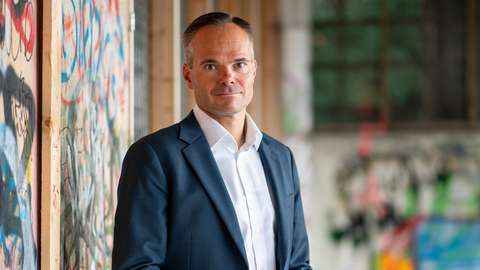
“Espoo's success impacts how all of Finland succeeds,” says Kai Mykkänen, Mayor of Espoo. The new Espoo story, i.e. Espoo's strategy for 2025–2029 focuses on the wellbeing of children and young people as well as managed growth for the city.
Espoo carries a proportionally higher responsibility for children. “At Espoo, the growth prediction for the number of children being born and the percentage of underage children in the city’s population is the highest in the country,” says Mayor Kai Mykkänen.
“For this reason, the future of Finland as a whole depends a great deal on how children and young people growing up in Espoo can get excited and discover how to succeed in life. Hopefully, some of them will get so excited that they start innovating and creating something new through entrepreneurship.”
The ideas presented by Kai are clearly shown in the new Espoo story, i.e. Espoo's strategy for 2025–2029. The main title of the story is “Espoo – The Capital of Children and Youth.”
“A key question regarding our success is how we can help non-Finnish speaking children succeed to ensure that our society will not be divided into winners and losers,” predicts Kai.
Moderate and managed growth
Another key policy of the Espoo story is related to the fact that in recent years, the City of Espoo has been the fastest growing large city in Finland.
“Now, we are making some corrections. We are seeking moderate growth and emphasise that growth also means a good, green cityscape. Espoo must have diverse residential areas with a good mix of owner-occupied and rental housing and family and studio apartments,” says Kai.
According to Kai, the corrections are reflected in concrete terms by the number of migrants sought in Espoo for the coming years.
“We have been growing in recent years at a rate of about 5,000 to 7,000 people a year, and the basic idea of the new strategy is that the rate could well be half that. In this case, financial sustainability, i.e. the management of service needs, would also be better.
Local nature is very important for people in Espoo
The Espoo story, which as approved by City Council in October 2025, has been in preparation since spring 2024. People residents have been asked about their home city's development needs in various instances, such as the My Espoo survey.
“Closeness to nature and greenness were clearly the most common wishes in the survey. They are also seen as key values in Espoo, which to a large extent have already been realised and are a source of pride,” says Kai.
According to the mayor, the appreciation towards nature and recreational areas goes hand in hand with managed growth.
“Take the master plan for the new Kiviruukki area, for example. When considering whether to add more or less apartments compared to recreational areas, we prefer adding to the quality of recreational areas instead of maximising the number of apartments,” he says.
“The goal defined in the strategy, where every Espoo resident should have to walk no further than 300 metres to the closest recreational area, also directly reflects the wishes expressed in the My Espoo survey.”
The roadmap has a direct connection with performance targets
Espoo's strategy has been narrative-based for 12 years already. Now, its structure has been updated.
“The roadmap guiding the implementation will be put into more focus,” says Kai.
The roadmap sets out the seven main goals defined in the strategy for the council term and the related, more detailed sub-goals, from which the budget's performance targets and indicators are directly derived.
“So, while keeping the narrative focus in the background, the roadmap is a concise list, and the budget’s performance targets are directly based on it and do not come out of a vacuum in relation to the strategy.
The city's employees have been involved in the preparation of the Espoo story along the way, and now the mayor hopes that the result will be reflected in everyday work.
“Hopefully, the Espoo story will offer an exciting reason for why we do our work. On the other hand, a strategy cannot be the same thing as a budget or action plan, but it needs to serve as a guiding star on our path. This is then reflected in everyone’s daily work and what we pay attention to in particular.
Finnish or Swedish reading skills for all children
Let us return to the heart of the Espoo story: children and young people. A majority, about four fifths of the city's 11,000 employees work with children and young people in early childhood education and care and schools. The mayor emphasises that while the financial situation is not easy, the Growth and Learning Sector must make investments that genuinely support the strategy’s policies.
“The challenges are great, and the percentage of students needing special support is constantly growing, for example. However, if you compare us with other cities, we continue to and must have the opportunity to focus more on growth and learning.
According to Kai, despite limited resources, efforts must be made to ensure, for example, that all children have a good level of reading in Finnish or Swedish, which has been identified as one of the main objectives.
“In a way, it sounds self-evident, but it is actually a very ambitious goal today.
Families and the whole City Group to participate in educational work
Kai emphasises that the Growth and Learning Sector cannot bear sole responsibility for the wellbeing of children and young people, but that this requires commitment on a much wider basis.
“We receive a great deal of feedback from Espoo residents on the wellbeing, symptoms and mental health problems faced by children and young people, and it is now the most important individual task of the entire city group to address this issue."
“And the strategy cannot naturally be implemented just by the city's employees, but we need families in Espoo to take on their own responsibility for the education of children and young people,” the mayor says.
Main goals of the Espoo story
- In Espoo, all children and young people can succeed and fulfil their potential.
- In a city with managed growth, all parts are enjoyable and safe.
- Espoo is moving towards carbon neutrality and improving the state of nature.
- Espoo is the best place for innovators, entrepreneurs and employees.
- Espoo succeeds in the face of opportunities and challenges brought by internationalisation.
- Espoo's economy is on a sustainable foundation.
- The personnel are healthy and makes use of partnerships.

How the new Espoo story is reflected in sectors
Growth and Learning Sector
Merja Narvo-Akkola, Deputy Mayor for Growth and Learning. The Growth and Learning Sector reaches out to almost 50,000 children, young persons and their guardians daily.
“The Espoo story raises clear priorities”
“One thing I like especially about the new Espoo story is that it does not try to cover all of our operations but highlights the key priorities. Everyday work continues as normal and the roadmap’s guidelines direct us to focus on what is essential and offers a good support. The priorities in the Growth and Learning Sector include improving reading and language proficiency and enabling all children and young people to reach their best.
The reading proficiency goal is comprehensive: It does not just apply to basic education but the entire learning path – even leisure activities. Young children need to be read to, so they become familiar with the language and the experience of reading, and many have a sensitivity to learning to read in early childhood. And reading proficiency comes in various forms: In addition to purely technical skills, there is a growing need for comprehensive literacy and, for example, digital literacy.
We are in daily contact, directly or indirectly, with almost all the residents of the municipality, so we also play a vital role in ensuring that Espoo succeeds in internationalising and that everyone who moves here, whether they speak a foreign language or not, can feel that they are at home in Espoo.
The fact that the early childhood education and school personnel work together is crucial in terms of reaching our goals. We in the administration are a support function and enabler. I believe that healthy employees also promote the wellbeing of children: healthy children and young people learn better and learning increases wellbeing.
In my opinion, the preparation process for the Espoo story was successful and inclusive: It involved constant interaction between the field and decision-making. I believe that many employees can hear their own voice in the contents, and I personally feel very inspired by the outcome.”
Urban Environment Sector
Olli Isotalo, Deputy Mayor, Urban Environment Director: The Urban Environment Sector is creating functional and enjoyable prerequisites for living and entrepreneurship in Espoo.
“The significance of environmental questions is constantly increasing”
“From the viewpoint of the urban environment, there are two important changes in the new Espoo story. The first is related to environmental questions, which include adapting the climate change and carbon neutrality and the availability of nearby recreational areas and urban green. These are not new to us, but their significance has continued to increase.
Another new and significant strategic focus is moderating growth. Previously, there has been talk of sustainable development and growth, but not explicitly moderating growth. It means an attempt to make the economy more sustainable and population growth more managed to ensure the wellbeing of the city.
Since resources cannot be increased significantly, we must concentrate on the most important things: we cannot do everything at the same time, but we must align the tasks. Concentration also means that while we may be doing less in terms of quantity, we can do better in terms of quality.
Naturally, moderating growth does not mean ceasing construction, as we have planning area capacity for several years. I believe that the new strategy can, in practice, streamline work when there is enough time to do so. On the other hand, we are seeking the acceleration of planning and permit processes, so the projects that are being promoted are progressing rapidly.”
Sector for Economic Development, Sports and Culture
Mervi Heinaro, Deputy Mayor for Economic Development, Sports and Culture. The Sector for Economic Development, Sports and Culture is improving the city's economic development and competitiveness as well as the role of culture and sports.
“The goals are genuinely shared – let us work together!”
“In 2024, we carried out our own analysis of how the functioning of economic development units should evolve in a changing operating environment, and this work is also reflected in the Espoo story. I believe that many units are now noticing that this is something they were themselves thinking about.
What is great about the Espoo story is that it is genuinely future-oriented and the goals are genuinely shared. All of the main goals include parts to which we can also contribute. For example, improving reading proficiency at libraries is an important task for us and the Growth and Learning Sector.
For the first time, the strategy clearly states that Espoo needs to improve the business environment in order to increase employee self-sufficiency. At every stage of the decision-making process, we must consider how to create new jobs.
Espoo's increasing diversity is a fact and on the other hand, a prerequisite for growth. In practical terms, when considering how to provide services in many different languages, how to help people to better integrate and meet each other, economic development units have a big role to play in employment and leisure activities, for example.
It is great that the Let’s get excited and improve together goal is also included. You have to do things together, not just within the city, but as a team, with partners and residents. It is a bit more challenging, but we get the best result by fitting various viewpoints together.”