Beach etiquette
When you follow the rules, you make sure that the beaches feel safe for everyone. On this page, we explain the role of lifeguards at the city's supervised beaches and the personal responsibility of every beachgoer. It also includes instructions on what to do in case of an emergency as well as the most important beach rules that help to prevent hazards.
Explore Espoo’s beaches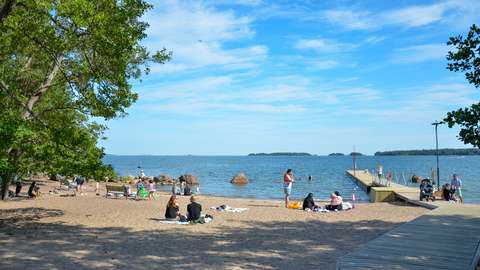
Beach etiquette and what to do in an emergency
- Follow the markings are rules of the swimming areas. Never swim alone and always swim along the shoreline. Safe areas are marked with buoys. Lifeguards supervise the flagged areas.
- Keep an eye on your children, both on the beach and in the water. They are the responsibility of their guardian even when the lifeguards are working.
- Be considerate of other beachgoers. Put your own rubbish in the bin and be nice. If you see anyone behaving inappropriately, stop them and notify the staff. Read about the principles of a safer space.
- Don’t bring your dog to the beach.
- Don’t smoke on the beach.
- Don't make an open fire at the beach. Campfires, disposable grills, portable grills, hobo stoves and other fireplaces placed directly on the ground are all considered an open fire. When the Finnish Meteorological Institute's wildfire warning is in effect, making a campfire is prohibited also in the beaches' official camfire sites.
- Follow the rules and regulations of the beach. They exist to make the beach a safer place for everyone. For example, it may be forbidden to jump from a pier because the water is too shallow. Please follow the rules.

What to do in case of emergency
- Call for help.
- Dial 112
- Throw out the life preserver
- Wade in and help
- Pul them to the shore
Download the 112 Suomi app(external link, opens in a new window) for your phone. It automatically relays your location to the emergency services. It helps the emergency service handle your call and send help from the closest possible unit.

Responsibilities of the lifeguards and beachgoers
Lifeguard responsibilities
Espoo’s supervised beaches are monitored by lifeguards, not rescuers. Their most important task is to make sure every swimmer is safe and to prevent hazards. Every lifeguard knows first-aid. They know what to do in case of an emergency and will call for help.
They also have general safety, cleanliness and maintenance tasks. The guards handle these tasks when it’s not their turn to supervise the beach.
Responsibilities of the beachgoers
Children are always the responsibility of their guardians.
Everyone has a duty to help others in distress and call for help if they see a hazard. It is also on everyone to stop inappropriate behaviour and report it to the staff.

Tips for swimming with children
Keep the child between the beach and yourself. This way, you can make sure that the child does not swim too deep.
Keep your child at arm’s length. Their stamina may run out quickly, which means you need to be able to help them quickly.
Remember that children’s floats are not rescue equipment. Various swimming rings, arm floats and similar flotation devices can help with learning to swim. Never leave your child unsupervised, even if they can swim with them on their own.
Source: Finnish Swimming Teaching and Lifesaving Federation(external link, opens in a new window)