Accessibility Index assessment revealed major differences between Espoo’s cultural centres
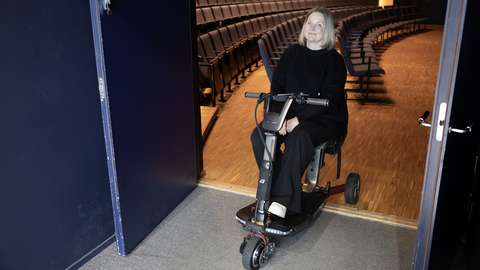
Exhibition Centre WeeGee and Sello Hall had the best result in an assessment conducted by the accessibility expert company Riesa. Kannusali and Espoo Cultural Centre received middle scores. The results of Children’s Cultural Centre Aurora were impaired by challenges related to mobility.
Riesa, the leading accessibility expert company in Finland, carried out an Accessibility Index assessment at Exhibition Centre WeeGee, Sello Hall, Kannusali, Espoo Cultural Centre and Children's Cultural Centre Aurora. The Accessibility Index is an indicator that provides an overview of the level of accessibility and highlights the key areas requiring improvement. Accessibility is examined in three areas: mobility, vision and hearing.
In an accessibility assessment, each site examined receives an index score on a scale of 0 to 100 (the higher the index, the better its accessibility). At the moment, the average of all sites indexed by Riesa is 70 (Riesa has assessed 284 sites).
WeeGee and Sello Hall had the highest scores among Espoo’s cultural centres
Of Espoo’s five cultural centres, Exhibition Centre WeeGee received the highest, or the best, Accessibility Index score (85), which is significantly higher than the average (64) of all museums indexed by Riesa (Riesa has assessed a total of 32 museums). The highest figures were given to accessibility information (100) and arrival (90). The lowest figure was given to services (80).
Sello Hall's result was close to WeeGee's result (81). In Sello Hall’s index, the highest figures were given to accessibility information (100) and services (87). The lowest figure was given to mobility (77). Henna Salo, Production Manager of Sello Hall, is delighted about the result and says that conducting the assessment required a joint effort.
“Professionals from all of Sello Hall's teams were needed for conducting the accessibility assessment as all of the activities in the building, from arriving and navigating in the premises to how the artists can move around backstage, are examined in the assessment,” Salo explains.
Sello Hall was opened in 2003, and at the planning stage, high thresholds were already excluded, the entrances were made spacious enough for persons using assistive devices, and the lighting was planned so that it can be adjusted and serves visual accessibility, among other things.
“Compared to sites such as concert halls that are over 100 years old, we did expect to get a good grade for accessibility. It was a positive surprise that our accessibility information and the accessibility of our services – for example, the cafe – are also very good. Most need for improvement was identified in the area of visual accessibility: for example, providing entrances with sound beacons that help persons with visual impairments to navigate public spaces and placing voice guidance in lifts would further improve the figures also in this area,” Salo continues.


Kannusali and Espoo Cultural Centre slightly above the average
Riesa’s average results were slightly exceeded in Kannusali (75) and Espoo Cultural Centre (73). Kannusali received the highest figures for services (87) and restrooms (85). The lowest figure given to Kannusali was related to arrival (55), which is partly explained by the fact that the hall is located in an underground civil defence shelter. In Espoo Cultural Centre, the highest figures were given to accessibility information (91) and arrival (77), and the lowest figure to restrooms (69).
Old buildings the reason behind Children’s Cultural Centre Aurora’s low result
Children’s Cultural Centre Aurora had the lowest score (55) among Espoo’s cultural centres in Riesa’s accessibility index assessment. In Riesa’s report, Aurora received the best scores for accessibility information (100) and restrooms (92). The lowest result was related to mobility (25).
Aurora has three buildings – one with an accessible entrance, another one with a wheelchair ramp by the side door and a third building, which does not have an accessible entrance at all.
“The buildings in the yard date from the late 1800s, and between 2002 and 2018, they were renovated for cultural use by respecting their history. For example, there are fairly small spaces and routes in each building, and thresholds between rooms. Accessibility requirements were taken into account in the premises where possible in connection with the renovations. Whenever assistance is needed, our customer service team is there to help all visitors,” says Aurora's production manager Johanna Kallionaho.
Riesa’s accessibility expert Atso Ahonen says that the introduction and use of Riesa’s Accessibility Index helps to understand the current situation in Espoo’s cultural centres and can be used to improve the facilities.
“The report helps to understand what has been achieved and what should be done next. The information is not tied to a person. Instead, the report helps to monitor accessibility issues in the long term,” Ahonen summarises.
The accessibility information of Espoo's cultural centres can be found on the websites of the cultural centres:
Exhibition Centre WeeGee’s accessibility information
Sello Hall's accessibility information
Kannusali’s accessibility information
Espoo Cultural Centre’s accessibility information
Children’s Cultural Centre Aurora's accessibility information
Read more about Riesa(external link, opens in a new window).
Text and photos: Sanna Uuksulainen