European cities sought solutions for more equal services
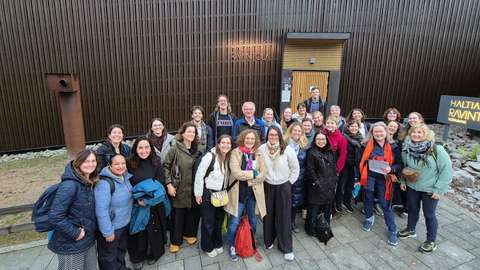
Experts from the Eurocities network got together in Espoo this week to discuss how cities can build services across sectoral and organisational boundaries. During the visit, the participants familiarised themselves with Espoo’s solutions, shared their experiences and identified ways to strengthen collaboration between cities.
Espoo hosted a joint meeting of the Eurocities Working Group on Migration and Integration and Task Force on Gender Equality from 5 to 7 October. About forty experts and decision-makers from across Europe attended the event. Alongside experiencing Finland’s nature and sauna culture, participants focused on discussions concerning their shared challenges.
Cities play a key role in immigration and integration issues, as they are responsible for many of the services that directly affect people’s daily lives. At the same time, city populations are becoming increasingly diverse and their service needs are changing.
“Many cities are dealing with the same questions as Espoo: how to respond to complex societal phenomena through services across sectoral and organisational boundaries. Participants were particularly interested in Espoo’s ways of linking goals related to integration, gender equality, inclusion and families’ wellbeing and promoting collaboration between different stakeholders. At the same time, we gained new perspectives from other cities and identified common areas for development,” says Development Manager Astrid Puumala-Thévenet.
What we learned from the meeting
One of the key lessons learned was that complex issues cannot be solved from a single perspective. Integration, equality and inclusion work requires a genuinely cross-sectoral approach. Success depends on close cooperation between experts from different fields, cities, non-governmental organisations, educational institutions and political actors.
The event also highlighted the importance of open dialogue where different European contexts are considered. Such dialogue is essential in building trust, both within and between cities.
In terms of integration and equality, it is important to understand that residents’ experiences and needs are influenced by multiple factors simultaneously, including their background, education, health, employment status, socioeconomic situation and gender. Discussions covered topics such as the situation of immigrant women and boys’ learning outcomes, highlighting that one solution or approach does not work for everyone.
Other cities learn from Espoo’s solutions
At the event, Espoo shared its experiences in developing city services. Participants learned how Espoo supports integration, families’ wellbeing, and inclusion.
A longer workshop held on Tuesday gave experts from European cities a chance to hear directly from Espoo communities and enabled mutual learning. In addition to immigration specialists from European cities, representatives of local organisations and communities took part in the workshop, enabling a valuable exchange of experiences.
Participants also visited Nice Hearts, Aalto University and Hello Espoo language courses. These visits focused on peer support, cooperation between schools and families, co-creation of services, and the coordination of language training and integration.
While learning about Espoo’s practices was an important part of the meeting, participants were equally interested in hearing about solutions developed elsewhere. Cities exchanged experiences on issues such as access to public services, paths to employment, skills recognition, building a sense of community, and designing services that respond to the needs of different groups.
Cooperation across service boundaries
Immigration, integration, gender equality, childhood and families’ wellbeing are often interconnected, yet they are dealt with separately within city organisations.
The meeting theme, ‘Beyond Silos – Building Cross-Sector Services for Gender Equality, Migration and Families,’ encouraged participants to consider how services and urban environments can be designed as entities where the diverse needs of women, children, young people and families are taken into account.
“From a resident’s perspective, city services are not divided into administrative sectors. That is why collaboration is needed both within the city organisation and between different stakeholders. International peer learning helps us realise where we can do things differently or better,” says Diversity and Inclusion Manager Kaarina Salonen.
The meeting also examined how cities can influence decision-making at the EU level. Shared experiences and challenges form the basis for Eurocities’ advocacy work, ensuring that cities’ perspectives are better heard in European decision-making concerning immigration and integration.
International cooperation benefits everyday life
For Espoo, the Eurocities network is an important channel for finding partners for EU-funded development projects and for showcasing the city’s expertise at the European level.
International cooperation through the network helps identify effective practices that can be adapted to local needs in Espoo.
“The value of Eurocities cooperation lies in what we learn and what we put into practice. When cities share solutions, a good local solution can benefit many cities. Collaboration also helps Espoo develop services that are more inclusive and effective and respond to the needs of different residents. The network also allows us to create partnerships for future EU-funded development projects. That is why it is important that Espoo’s expertise and good practices are widely known among European cities,” says Head of International Affairs Milla Ovaska.
Eurocities(external link, opens in a new window) is a multisectoral advocacy and learning network of over 200 large and medium-sized European cities. The network shares expertise, carries out joint projects and helps ensure that EU-level decision-making takes better account of cities’ perspectives. Espoo is actively involved in groups working on digitalisation, business, culture and environmental issues.
Enquiries
Hanna Eskelinen, specialist of International Affairs, +358 43 8273491, hanna.eskelinen@espoo.fi.


