HSY’s report: Espoo’s forests absorb more than 100,000 tonnes of carbon dioxide annually
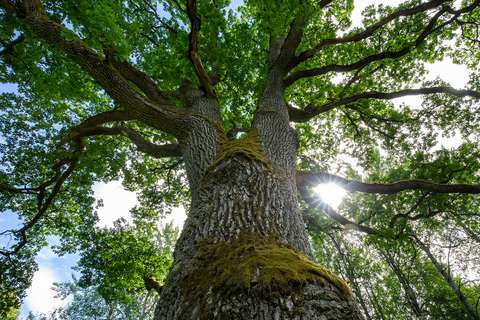
Espoo’s forests absorb a significant amount of carbon dioxide from the atmosphere each year, according to the new carbon balance report by Helsinki Region Environmental Services Authority, HSY. According to the report, the city’s forests and other vegetation act as a carbon sink, absorbing approximately 113,000 tonnes of carbon dioxide annually.
HSY’s carbon balance report examined how the land use sector, i.e. land use and vegetation (such as forests, fields, green spaces, wetlands and yards), absorbs and releases carbon in the capital region.
In Espoo, carbon sinks are concentrated in forested areas. For example, the extensive forest areas in northern Espoo and Espoo’s Central Park are significant carbon sinks. Green infrastructure in the built environment, such as parks and yards, also functions as carbon sinks.
Agricultural land is a significant source of carbon emissions, particularly peatland fields and forests on drained peatlands. Converting green spaces into built-up areas also reduces carbon sinks.
“Although Espoo has the largest carbon sinks in the capital region, the city continues to grow. That is why we are focusing construction primarily on existing built-up areas, centres and locations with good public transport connections. In this way, we aim to curb emissions and preserve our carbon sinks,” says Olli Isotalo, Deputy Mayor for Urban Environment at the City of Espoo.
Report provides more realistic information for land-use planning
The newly completed report is the first comprehensive assessment of Espoo’s carbon balance based on such detailed information. Compared with previous carbon sink calculations for the capital region, the report takes changes in land use into account, uses up-to-date growth models, and applies the principles for greenhouse gas calculation used in the national land-use sector.
The report provides a more realistic picture of where carbon is being absorbed and where it is being released. At the same time, it offers new and useful information to support land-use planning.
“The report will help us examine area-specific changes in the carbon balance. This helps us plan land use in a way that minimises the impact of construction on carbon sinks,” says Planning Manager Paula Kuusisto-Hjort from Espoo’s City Planning Department.
Carbon sinks are only part of the picture
Across the capital region as a whole, carbon sinks offset only a small share of the greenhouse gas emissions generated in the area. In Espoo, too, their impact remains limited in relation to the city’s total emissions. According to HSY’s report, natural carbon sinks absorbed some 15.9% of Espoo’s greenhouse gas emissions in 2024.
As part of its goal to be climate-neutral by 2030, Espoo has set a target that, after emission reductions, the remaining 20% of its climate emissions, or 212,000 tonnes, will be absorbed by carbon sinks or offset through other means. At present, Espoo’s carbon sink capacity is only about half the level needed to achieve this target. Reaching the climate neutrality goal will therefore require additional measures to accelerate emission reductions.
“Carbon sinks are an important part of the overall picture, but they cannot replace emission reductions. The report provides a good overview of Espoo’s carbon stocks and sinks. This information is valuable as we conduct the mid-term review of the Climate Neutral Espoo roadmap and assess whether our climate measures are sufficient,” says Olli Isotalo, Deputy Mayor for Urban Environment at the City of Espoo.
The updated Climate Neutral Espoo roadmap and a proposal for additional measures to reduce emissions will be presented to the City Board on 31 August 2026 and to the City Council during the autumn.