Well-being, health and inclusion work receives 500,000 EUR in organisation grants supported by resident feedback
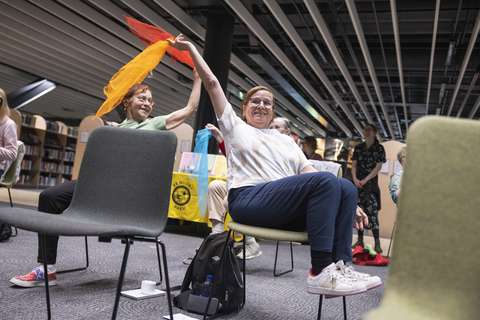
The annual organisation grants for promoting wellbeing, health, and social inclusion have now been given out. Feedback collected from Espoo residents through the Voxit platform was used to support decision-making.
Organisation work adds to the city’s services
Organisations around Espoo offer a variety of preventive services and services that support the meaningfulness of daily life. The work of organisations can often even reach such people who, for one reason or another, do not participate in the city’s activities. This is why organisations are important partners in supporting the well-being, health, and social inclusion of residents, and we award annual organisational grants to various organisations that promote these themes.
The organisation grant for well-being, health, and social inclusion work is mainly intended for registered non-profit organisations that meet the general requirements for the grants for well-being, health and social inclusion and that do not receive other grants for the same activities from the City of Espoo. Organisation grants have been handed out since 2024.
The amount of organisation grants for promoting wellbeing, health and social inclusion given out this spring totalled 500,000 EUR between 87 different organisations. The application period for the grants ran from 12 to 30 January 2026.
Local residents as part of decision-making
The decision on the grants is ultimately made by the Sports and Wellbeing Committee on the basis of previously agreed upon principles. This time, however, the committee were also supported by what could be called a resident panel. Opinions on what should be highlighted when granting support for organisations promoting well-being, health and social inclusion were collected on the Voxit platform, which is open for everybody.
Voxit is an anonymous chat forum where the discussion is based on various statements. Both the poster starting a discussion and the people participating in the thread can add their own statements to the platform, and others can then agree or disagree with these statements. The platform makes it possible for a diversity of voices and opinions to emerge, but the lack of a comment field ensures that discussions don’t get out of control.
We piloted the platform for five different discussions this year as part of the EsVoxit inclusion project co-financed by Sitra. In the discussion which was open from 2 to 22 February 2026, we asked the following question: how should we decide on organisation grants for the promotion of well-being, health and social inclusion when more applications meet the application criteria than there are grants to give out?
The help was sorely needed, since the amount requested through applications came to a total of EUR 1,456,005 this spring, which is almost three times the sum that could be granted.
Priority given to quality and regularity
A total of 174 people participated in the Voxit discussion on organisation grants. In general, the respondents thought that the work of the organisations is important, as is giving them grants. Many found it difficult to prioritise one theme over the other, and no significant differences were seen between the most important target groups or different implementation methods.
The respondents were clearly in agreement that the grants should primarily focus on high-quality activities. The responses showed that support should be targeted at stable organisations whose activities are continuous, transparent, and effective. Cooperation between different operators was also appreciated. Out of the provided themes, the respondents found work aimed at integration, language skills, and cultural interaction to be particularly important.
The results of the discussion were used to support decision-making in addition to previously determined grant principles and scoring practices. For example, the voice of the residents steered the decisions to put particular emphasis on regular and cooperative activities. In terms of demographics, the committee ended up deciding to emphasise services aimed at foreign-language speakers, older people, and those in a vulnerable position.
The Sports and Wellbeing Committee assessed the experience of utilising the resident panel through a survey. All respondents had, at least to some extent, read through the views collected from residents. 60% considered that the residents’ views had affected their ideas. One respondent said that the voice of the residents “supported decision-making and offered certainty”. Each respondent felt that the residents’ views were a good addition to the background material for decision-making.