The Educational Partnership project is moving forward in Espoo – cooperation between guardians and schools is being developed through participatory methods
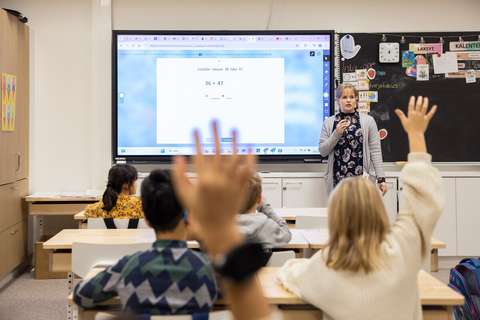
The two-year project explores and develops cooperation between guardians and schools using service design methods. The goal is to support the learning of children and young people and to prevent educational and social segregation.
The joint Educational Partnership project between Aalto University and the City of Espoo has been launched in collaboration with three schools in Espoo: a primary school, a lower secondary school, and a comprehensive school. The project is being implemented by the Department of Design at Aalto University and City of Espoo’s Department of Growth and Learning.
The goal of the project is to strengthen the educational partnership between schools and parents as a joint effort by the entire school community. To this end, new operating models and tools are being developed to support this collaboration.
“We’ve been able to involve parents from a wide variety of backgrounds, and there’s a clear enthusiasm in schools for developing partnerships with parents. Teachers and other staff are also highly motivated to do this”, says Annukka Svanda, project researcher at Aalto University.
Through interviews with guardians and school staff, as well as participatory workshops, concrete and inspiring insights have emerged for developing cooperation between guardians and schools. Using participatory design methods, Espoo has been able to reach and listen to guardians from diverse backgrounds and genuinely incorporate their perspectives into the development work. This is important to ensure that the collaboration reflects the everyday lives of different families and supports the learning of all children equally.
“It’s important that we’re heard and given the chance to participate. Our message gets through and has an impact”, says a guardian who participated in a workshop with a multicultural families organization.
“Schools are already doing a lot of good work in collaborating with parents and guardians. In this project, we aim to identify how this collaboration can be made even clearer, smoother, and more equitable, so that every family finds its place in the partnership and every child has the best possible conditions for learning,” says Svanda.
New approaches to collaboration
Through the project has been identified that it is not always clear to all guardians, regardless of their cultural background, what their role is in the day-to-day life of the school and what is expected of them. At the same time, schools and teachers have varying practices when it comes to collaboration and supporting guardians.
“The aim is to create a common foundation for collaboration between guardians and schools”, Annukka Svanda explains.
For the City of Espoo, the key objective of this project is to develop a cohesive and successful path for growth and learning for all children and young people in Espoo.
“As the capital city for children and young people, our goal is for every family to have the opportunity to participate and be heard in the partnership between home and school” says Juha Nurmi, Director of Basic Education.
“It is also important that we seek new ways to implement this educational partnership based on research and in collaboration with guardians,” Nurmi continues.
“Through our participatory working methods, schools have gained the opportunity to hear guardians’ experiences of collaboration and receive practical suggestions for, for example, developing parent-teacher meetings and strengthening the sense of community among guardians”, Svanda explains.
The partner schools view the project as necessary and timely.
“We really need much more research and partnerships like this. Warm, open, and trusting interaction is the key”, says Marika Ketomäki, acting principal of the partner school Matinlahti.
The Educational Partnership project will continue until the end of 2026. The project will result in the development of an operational model that supports cooperation between guardians and schools and can be utilized more widely in Espoo and potentially adapted for use elsewhere in Finland.
For further information:
Doctoral researcher Annukka Svanda, Aalto University, annukka.svanda@aalto.fi
Juha Nurmi, Director of Basic Education, City of Espoo, juha.nurmi@espoo.fi