Material bank for exergames
Welcome to explore the possibilities of exergames! This material bank brings together ideas, examples and practical tools for how digital exercise games can increase everyday physical activity and support the objectives of early childhood education and care and primary, lower secondary and upper secondary education.
What is digital exercise gaming?
Digital exercise games, called exergames, are a form of digital gaming that combine video games with physical activity and where the player’s physical effort determines progress in the game (Mueller et al. 2011). In many exergames, the player’s own body serves as the controller.
The key strength of exergaming is combining fun and benefits. Physical activity often comes to the player as a by-product of gaming without the player even realising that they are exercising.
In Espoo, exergames have been tested at all levels of education, in sports facilities and in the library. Exergames have generated more than 2,000 hours of everyday exercise each year. During the Exercise Through Games project alone (1 September 2024–31 December 2025), more than 118,000 game sessions were had around Espoo
Embedded content cannot be displayed
Why use exergames?
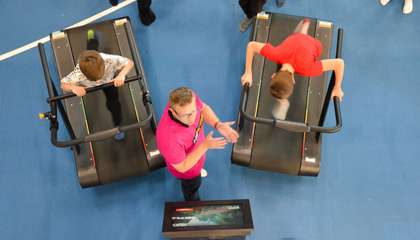
What kind of exergame solutions exist?

Procurement and introduction checklist
To ensure that the procurement and introduction of exergames is as smooth as possible, it is advisable to read this checklist in advance. The checklist below summarises the key issues that you should consider already in the planning stage of the procurement – then you are sure to succeed!
Data protection
An exergame solution is a digital tool, so it is important to be aware of data protection issues. Whenever planning a new digital procurement, a basic-level risk assessment of data protection is carried out. Preparing a basic risk assessment before processing personal data is a prerequisite for establishing and maintaining an appropriate level of data protection and security. Based on the assessment, it can be concluded whether more detailed assessments are required (such as DPIA). The contact persons of the City’s data protection units help you ensure that the solution is suitable for its operating environment.
The data protection risk assessment process in the City of Espoo is the following:
- Data protection risk assessment
- Risk level?
- No risk – no processing of personal data --> No data protection measures
- Normal --> Basic risk assessment
- High --> Impact evaluation
Information management
Find out if the device or application requires the approval of City Information Management (e.g. devices connected to the network, IoT solutions). If the device does not work in its own separate network or without a network connection, work with City Information Management to find out how the device can be used safely in your environment.
Most solutions require an internet connection at least for the duration of updates. Some of the solutions work without a network, or they are delivered fully equipped with their own separate internet connection.
If the device is not pre-equipped with its own separate internet connection, and it is not wanted in the City’s network because of this or for another reason, a separate SIM card and data plan can be ordered for the device. The order for the data plan is made through Hector.
Space requirements and device placement
As a rule of thumb, it is a good idea to reserve an area of approximately 3x3 metres for an exergame device. The devices require electricity, which is why you should consider the proximity of the electric socket.
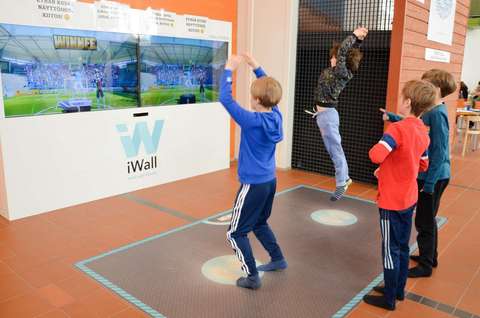
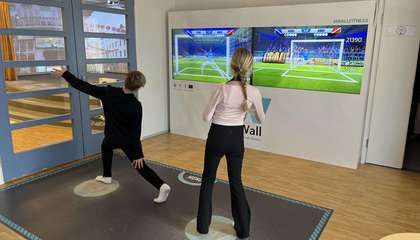
For safe use, some devices (such as iWall and cycloBEAT) must be bolted either to the wall or the floor. Some devices do not require attachment, and some are movable on wheels. Particularly for interactive exergame floors used in daycare centres, it is advisable to check how slippery the surface is and use anti-slip mats, if necessary.
To avoid surprises, check the space and technical requirements with the device manufacturer.
The following should be taken into account when placing a device:
- The joy of exercise can be loud. As such, you should examine the acoustics in advance. For example, an exergame in front of the gym may not be a good idea while students are inside taking their matriculation examination.
- The optimal location of the device varies depending on the school level and unit in question.
- Proven places in primary and lower secondary schools include lobby spaces and other open spaces that see a lot of by-passing traffic.
- In some upper secondary units, the best location for a exergaming device may be a more remote corner where the game can be played in peace without a large group of viewers.
- When looking for the ideal placement, you should consider whether the device is primarily intended for breaks or lessons or for entirely independent use.
Training needs
Is separate user training required for exergames? This depends on the exergame solution. The majority of devices and other solutions are so easy and user-friendly in terms of user interfaces that at least students in comprehensive school or upper secondary school are able to use them by themselves, and no training is required.
The device manufacturer can guide your unit with the exergame solution if you need training in the early stages or annually, for example.
In early childhood education and care, where gaming is always guided and not self-motivated, user training plays an important role. However, the training sessions are often short, only an hour, which makes the game deployment light despite the training.
The personnel are the key to embedding exergame activities. It is a good idea to have a joint discussion on how an exergame solution can be used as part of increasing everyday activity and teaching.
Costs, licenses and maintenance
In all cases, the total cost of an exergame solution does not consist of just the purchase, but using the solution may also require monthly licences. In other words, find out all possible costs:
- purchase or lease cost
- any monthly licences
- potential maintenance fees
- transfer fees if you want to change the location of the device and the device is not mobile.
Verify who is responsible for managing licenses and at which level (unit, service area, etc.).
Practical tips for the pedagogical utilisation of exergames
Exergaming combines physical activity, learning and enthusiasm for the digital culture. At their best, exergames support the curriculum and increase students’ attachment to their school. These practical tips and use cases help make exergames a natural part of the day of early childhood education or school.
Exergames introduce experiences to teaching
An example from Viherlaakson koulu shows how an exergame device can be used to introduce experiences to teaching and thus create a stronger memory trace for the students. In Viherlaakson school, this was implemented as part of an extensive learning module on the Nordic countries. The teaching was constructed so that the students first completed assignments in the classroom, after which they moved on to the iWall exergame wall. It was used for virtual ski jumping in Holmenkolmen, Norway, skiing in Åre, Sweden, and kayaking in Latvia.
In early childhood education and care, exergaming touches on many education objectives. The pilot examples of Metsola and Jousenkaari daycare centres show that an exergame can be a part of all-day pedagogy:
In addition to physical activity, the Fly Sky exergame floor teaches children about topics such as recycling and observation of the environment, identifying the sounds of different animals, building vocabulary, and learning to queue and work together – by walking, running or crawling.
The experiences inspire children, and during the exergame pilots, the children began to come up with ideas and games of their own. A fishpond on the interactive floor turned into an oasis of mermaids, where the children started practising swimming movements.
Accessibility
Exergaming offers opportunities for all kinds of users to experience successes and participate in shared social moments. When planned carefully, exergames can support inclusion, lower the threshold for participation and open up completely new ways of exercising even for those for whom conventional physical activity is challenging.
In general, exergames are inclusive:
- They do not require physical skills or special skills.
- They are mostly language-neutral and visual.
- In most cases, gaming areas can be adapted for both standing and seated players.
- Students using assistive devices can participate equally.
In the Espoo pilots, the games also made exercise possible for students using wheelchairs, special support groups and those who do not enjoy traditional sports environments.
Exergames in Espoo
Exergames have been utilised in Espoo to increase everyday physical activity since 2021. The exergame pilots began with the EU project “Modernizing Sport to Foster a New Active Generation” (2022–2024), which you can read about here. The EU project carried out more than ten pilots combining digitalisation and physical activity or sports. In this project, the functionality of exergames was first identified to increase everyday physical activity when exergames were utilised at Espoo sports facilities and library.
Exercise Through Games project
Work on exergames continued in the Exercise Through Games project (2024–2025), which you can read more about on the project website here. The project carried out more than 40 exergame pilots, this time in Espoo’s units for early childhood education and care, and primary, lower secondary and upper secondary education. The results were delightful:
1. A total of more than 3,000 hours of everyday exercise was generated during the project.
2. 93% of those who participated in the pilots felt that exergaming increased everyday physical activity.
3. 69% of the pilot participants used exergames as part of teaching or other guided activities.
4. 100% of those who participated in the pilots wanted to continue playing exergames in their unit
The material bank for exergames has been compiled on the basis of the lessons learned from the Exercise Through Games project.
Sources
Goncalves, A., Lespiau, F., Briet, G., Vaillant-Coindard, E., Palermo, A., Decobert, E., Allegret-Bourdon, N. & Charbonnier, E. (2024). Exploring the use of a learning-based exergame to enhance physical literacy, soft skills, and academic learning in school-age children: Pilot interventional study. JMIR serious games, 12, e53072.
Kari, T. (2017). Exergaming usage: Hedonic and utilitarian aspects. Jyväskylä studies in computing 260 (Doctoral dissertation).
Marsigliante, S., My, G., Mazzotta, G., & Muscella, A. (2024). The effects of exergames on physical fitness, body composition and enjoyment in children: A six-month intervention study. Children, 11(10), 1172.
Medeiros, P. D., Capistrano, R., Zequinão, M. A., Silva, S. A. D., Beltrame, T. S., & Cardoso, F. L. (2017). Exergames as a tool for the acquisition and development of motor skills and abilities: A systematic review. Revista Paulista de Pediatria, 35, 464-471.

The data measured by exergaming equipment shows that almost every exergame session in Espoo is social. In other words, at least two players are involved in the exergame.
Exergaming brings children and young people together in a way that transcends age and skill level. Sports-specific skills are not needed in for the exergame performance. Instead, everyone is able to play the games regardless of their starting level.
Exergames encourage interaction and cooperation: players can solve challenges together or compete in a friendly spirit. This supports a sense of community and strengthens social skills, such as interaction with others, group dynamics and taking others into consideration.
“Our students have been able to practise physical activity and social situations at a low threshold thanks to the game. It has even been remarkable how gaming has worked across classroom boundaries, also between students in primary and lower secondary school.” - Comprehensive school that piloted an exergaming wall
“Our students have been able to practise physical activity and social situations at a low threshold thanks to the game. It has even been remarkable how gaming has worked across classroom boundaries, also between students in primary and lower secondary school.”
- Comprehensive school that piloted an exergaming wall
“Playtime on the interactive exergame floor simultaneously develops many of the objectives of early childhood education. These include cooperation skills, resilience to disappointment, waiting for one’s turn, language learning and academic skills in areas such as mathematics or recycling. Games provide experiences and experiences of inclusion for each child at their own skill level.”
- A daycare centre that utilises exergaming in its activities
Different exergames serve different types of movement: you can crawl, run, walk or use a wheelchair on the exergame floor. Barriers to physical activity are reduced in exergames, as games offer more accessible and inclusive options for experiencing physical activity than traditional exercise.