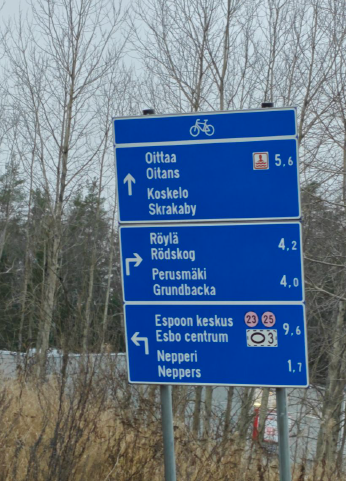
Cycle route signage in Espoo
BuildingThe whole EspooLocation
EspooPhase
Construction
Project description
The contract involves the installation of new direction signs for cycling throughout the city. The aim of the project is to make cycling smoother and to provide clear and uniform direction signage around Espoo. Installation work will begin during 2025 and continue until summer 2026. Some signs will be installed after summer 2026 during other roadwork projects.
Direction signs for cycling are new road signs introduced in 2020 with the revised Road Traffic Act. The new signs guide cyclists to various destinations along direct, logical and safe routes. Various other aspects have also been taken into account when planning the routes. These include hilliness, the quality of winter maintenance, and the number of crossroads with traffic lights. The direction signs provide information on the different routes to cyclists as they travel.
The new direction signs for cycling also contain new information for cyclists. The new additions include symbols and distance information. In addition to symbols mandated by the Road Traffic Act, the signs also indicate the regional main routes with numbers on pink or yellow background. The pink regional main routes are contained within Espoo, while the yellow routes extend outside the city. The purpose of a regional main route is to connect two important sites. The Eurovelo 10 route is marked with an emblem consisting of stars and the number 10. Eurovelo 10 is a scenic tourist route that goes around the Baltic Sea. It extends beyond Finland’s borders. The direction signs indicate the remaining distance to a named site in kilometres. The given distance is usually the distance to a square, a station or other significant area within the site. The direction signs only have a guiding role; cyclists are not required to follow them.
In addition to the direction signs for cycling, other signs will also be installed during the project. If necessary, sites inside Espoo will have place name signs for cyclists, indicating arrival at a destination. Place name signs will also be installed on the routes at Espoo’s border, informing cyclists that they are leaving the City of Espoo. Ultimately, all traffic signs will form a single network that will serve cyclists both within the city and in neighbouring municipalities.
The new signs will be installed throughout the City of Espoo, except for some sparsely populated areas and recreational areas. Most of the signs will be installed in dense urban environments that have a large number of route choices and cyclists. The direction signs will ultimately form a single, coherent and well-guided network. More signs will later be installed in Kauniainen and on the highways of Espoo (and possibly on the highways of Kauniainen) through separate contracts.
During the installation phase, residents may notice short-term construction sites in various parts of Espoo. The installation work may cause noise and some temporary obstacles for traffic. Worksite arrangements will be planned with the safety of other traffic users in mind. The most important thing for residents is to comply with all given instructions near worksites and to follow the temporary traffic arrangements. Once the new signs are in place, they will make the routes more easily understandable and support safe and predictable mobility.
Direction signs for cycling have already been developed and installed in several cities in Finland. These include cities such as Rovaniemi, Oulu, Lahti, Tampere, Turku, Helsinki and Vantaa. Espoo’s new direction signs have been planned in cooperation with Ramboll Finland Oy. The installation is carried out by Destia Oy. The City of Espoo is responsible for coordinating the project and will, if necessary, publish up-to-date information on its website as the project progresses.
The signed routes will soon be added to the Espoo map service. People can use the map service to plan their travel and to check how suitable the signed routes are for different mobility needs.
The direction signs for cycling are part of the broader goal of making sustainable mobility smoother, safer and more intuitive for everyone. The City of Espoo encourages residents to familiarise themselves with the new signs and to provide feedback through the feedback system. With feedback, the service can develop together with the users.
Basic information about the project
Schedule: October 2025–June 2026
Project supervisor: Destia Oy, maintenance
City developer’s representative: Jonas Lindgren