e seen and heard in traffic: Espoo’s cycling stand drew hundreds of visitors
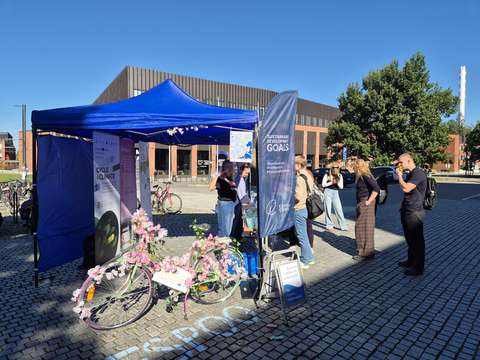
The City of Espoo’s sustainable mobility experts took part in the Aalto Welcome Fair event in Otaniemi on 27 August. This year’s cycling stand was themed “Be Seen and Heard in Traffic.” During the day, nearly 400 visitors stopped by the stand, many of whom had arrived in Finland and Espoo only a few days earlier.


The Aalto Welcome Fair is an event designed especially for new students, where Aalto University and its partners present services and opportunities that support student life. At Espoo’s cycling stand, new students were introduced to cycling as an easy, affordable, and sustainable way to get around in their new home city.
Discussions focused particularly on Espoo’s cycling routes, winter maintenance, city bikes, year-round cycling, and opportunities to purchase a bicycle second-hand. For many international students, the Finnish winter and cycling during a dark and slippery season were unfamiliar concepts, so there was considerable interest in how cycling and cycling routes are maintained throughout the winter.
The stand also highlighted the importance of visibility in traffic. Visitors could spin a prize wheel to win items such as reflectors, bicycle repair kits, saddle covers, and sustainable development lanyards.
"For new students, cycling can be one of the first ways to explore Espoo and their new everyday environment. That is why we want to inform them right at the beginning of their studies that cycling is possible here all year round and that the city continuously develops both cycling conditions and services that support cycling. At the same time, being visible in traffic and travelling safely are things that everyone can influence themselves," says Development Manager Mari Päätalo from the City of Espoo.
Students found Cycling Traffic Volumes Interesting
Students were also introduced to the cycling traffic display boards located in Tapiola and Otaniemi. These boards show cyclists the volume of bicycle traffic in the area while also making cycling a visible part of the urban landscape. The display boards and the associated counters were implemented as part of the Cycle4Climate project.
The idea of making cycling volumes visible received positive feedback from students. However, most visitors to the stand had not yet noticed the display boards in Otaniemi and Tapiola. This was not particularly surprising, as many of the new students had only been in Espoo for a few days.
Espoo’s cycling infrastructure also received praise during the discussions. Feedback from students confirmed that convenient routes and good maintenance are especially important when a new resident is still learning how to navigate the city.
Sustainable Mobility Is Built on Infrastructure, Services, and Knowledge
Espoo’s sustainable mobility projects Cycle4Climate, SOLMU, and Mobilities for EU were represented at the Aalto Welcome Fair. While the projects approach sustainable mobility from slightly different perspectives, they share a common goal: making sustainable modes of transport easier and more attractive.
The Cycle4Climate project seeks and tests ways to increase year-round cycling and reduce transport emissions. In Espoo, activities focus particularly on the Tapiola, Otaniemi, and Keilaniemi areas. The cycling traffic display boards are one example of measures that make cycling and cycling volumes more visible in the urban environment.
The SOLMU project focuses on developing mobility services and transport hubs so that walking, cycling, public transport, and other services can be more easily combined into seamless travel chains.
Through the Mobilities for EU project, Espoo develops and pilots future sustainable mobility solutions together with businesses, higher education institutions, and residents. The project’s Espoo Mobility Lab brings together different stakeholders and helps identify future mobility needs as well.