Divided opinions on concerts in the Vermo area – they improve the city’s image but noise and spillover effects are a drawback
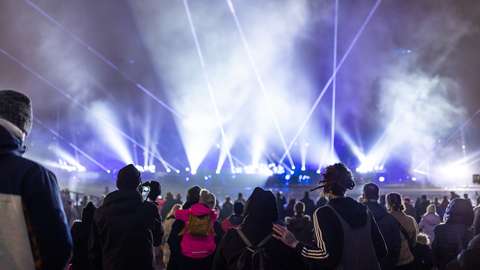
Residents in the surrounding area are generally positive about events held in Vermo, but experiences of negative impacts increases resistance to events. Residents would also like to receive better advance information about concerts. These opinions became clear in a survey commissioned by the City of Espoo’s Environmental Protection, which examined the views of residents living near Vermo concerning concerts and other outdoor events held at the harness racing track. A total of 485 households located near Vermo responded to the survey conducted by Taloustutkimus Oy.
This extensive survey was conducted in late 2025 and early 2026. A total of 2,500 randomly selected households living within approximately one kilometre of Vermo were invited to participate in the survey. This included the neighbourhoods of Vermonniitty, Perkkaa, Vermonrinne and Mäkkylä in Espoo as well as Pajamäki and other neighbouring areas located in Helsinki. The response rate was 19.4%.
Vermonrinne has the most critical opinions
Based on the survey, the attitudes of local residents to concerts are divided: 55% of respondents feel that concerts improve the image of the city and 47% the image of their own residential area, while 21% see concerts as damaging to the image of the city and 16% to the image of their own residential area. At the same time, a significant portion of residents experiences disturbances related to noise and secondary effects of concerts. In total, 56% of the respondents felt that concerts at Vermo have caused at least some noise in their home even when the windows were closed.
There are large differences between the neighbourhoods. Of all survey respondents, the residents of Vermonrinne have the most negative views – up to 70% indicated that concerts reduced living comfort, and more than half would prefer to be away from home during the concerts. On the other hand, living comfort in Perkkaa decreased by 21%, and less than one fifth of the residents would prefer to be away from home during concerts.
Response activity also indicates that proximity to Vermo and the perception of negative impacts is linked to a greater interest in the topic. The highest response rate was in Vermonrinne, where 42.5% of the households that were invited to participate responded to the survey. Residents living farther away in Perkkaa were less enthusiastic about responding to the survey, and their response rate was only 8.3%.

Residents would like to receive better information about the events in advance
Only about half of the respondents felt that they had received sufficient information about the concerts in advance. It is the responsibility of the concert organiser to distribute a bulletin on the upcoming event to residents in the surrounding area. However, only just under half of the respondents said they had received a bulletin by post, and one third said that they had not received any bulletin at all. In addition, one third of respondents reported that they had not received sufficient advance information on concerts through other channels.
According to the survey, 35% of residents who strongly disagreed with the statement that communication had been sufficient before the concerts felt that noise interfered with sleep a lot. The same figure is only 9% for respondents who strongly agreed with the statement that communication was sufficient. The difference is nearly fourfold. Successful communication had an even greater impact on living comfort. For those who strongly agreed with the statement that communication was sufficient, living comfort was 12 times higher than among those who strongly disagreed. This demonstrates that communication is a very effective way to reduce the negative impacts experienced by residents due to concerts.
A bulletin distributed to households by the event organiser is the primary way of reporting the possibility of excess noise. It is easier to accept temporary noise when you know what to expect and when it will end.
Residents would set different rules for events than the city
The survey also examined residents’ opinions on Espoo’s policies for events. The City of Espoo’s Environment and Building Control Committee has set policies concerning the ending times, frequency and maximum number of outdoor events at different venues. According to the event policy, concerts must – as a rule – end no later than midnight, and a maximum of four event days ending at 22:00–24:00 can be held at Vermo each year. In addition, there must be at least one full week and weekend between events lasting several days.
According to the survey, residents would allow an average of 10.5 event days during the summer season between May and September, but the residents of Vermonrinne would only accept 5.8 event days. The residents feel that a reasonable time to end a concert is approximately 22:30 on weekdays and midnight on weekends. Only about 25% of the residents responded that the appropriate frequency for concerts is every other weekend or more often, while the city policy allows concerts every other weekend. The city’s current policy is therefore considerably stricter than the residents’ opinion concerning the number of event days, but looser in terms of ending times and especially the frequency of events.
The results of the survey will be used to prevent the negative impacts of noise
The survey provides the City of Espoo with important information on the negative impacts that concerts have on residents, how reasonable the impacts are and how they could be reduced. The results will be used to determine a level for the negative impacts of concerts that is acceptable for local residents.
The City of Espoo’s Environmental Protection will utilise the results of the survey when preparing future decisions concerning noise notifications for events in the Vermo area. The results will also be used to consider what kind of noise abatement measures are required of event organisers and to update the policies on events in general.
Residents are heard in connection with noise notifications
The organiser must notify Environmental Protection of concerts and other events that end late and cause noise that may be particularly irritating. The City of Espoo publishes a public announcement of a noise notification it has received on its website, and residents in the neighbouring area have the opportunity to present their views on the notification within the consultation period.
At the time of publishing this news item, no noise notifications had been submitted to Environmental Protection concerning events being organised in Vermo in 2026. For example, Weekend Festival has announced on its website that its concert dates will be from 31 July to 1 August 2026.